
Commercial Solar Panel Installation: The 2026 Business Guide to ROI and Energy Security
By 2026, the most resilient UK businesses won't just be those with the best products, but those that have decoupled their operational costs from the volatility of the national grid. You've likely felt the sting of unpredictable energy tariffs and the growing pressure to meet strict Scope 2 emission targets. It's a significant challenge to balance fiscal growth with environmental responsibility, especially when faced with the technical hurdles of G99 grid applications and planning permissions. Many forward-thinking companies are now prioritising solar battery storage as a strategic move to lock in long-term energy security.
This guide demonstrates how professional commercial solar installation can slash your operational overheads and provide genuine energy independence. We understand that your priority is a compliant, high-standard system that requires minimal oversight from your management team. We'll walk through the latest 2026 ROI projections, the benefits of integrating battery storage, and the logical steps to achieving a seamless, contractor-led installation that protects your bottom line for years to come.
Table of Contents
The Strategic Business Case for Commercial Solar Panel Installation
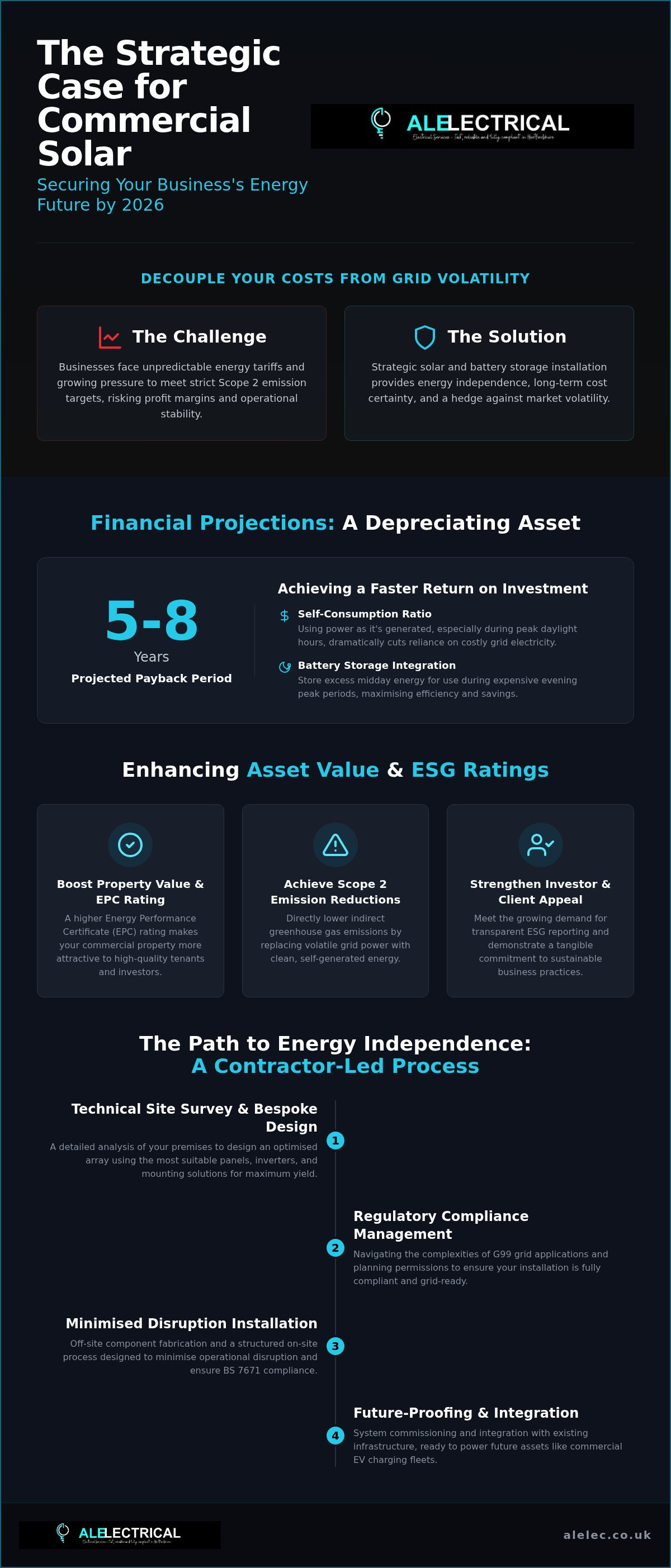
Investing in commercial solar isn't just about environmental stewardship; it's a calculated financial hedge against an increasingly unpredictable energy market. By generating power on-site, businesses transform a volatile monthly expense into a predictable, depreciating asset. This shift provides long-term budgetary certainty that traditional energy procurement simply cannot match. When you own your generation capacity, you're no longer at the mercy of global supply chain shocks or sudden tariff hikes that can erode your profit margins overnight.
Energy security is the other side of the financial coin. Grid reliance is a growing risk, especially during peak business hours when demand and costs are at their highest. A professional solar installation reduces this dependency, ensuring your critical operations have a buffer against grid instability. It's a move that offers genuine peace of mind for directors who need to know their infrastructure is as resilient as it is cost-effective.
Calculating Your Payback Period in 2026
The speed at which a system pays for itself depends on several variables, including the total size of your roof array, your self-consumption ratio, and current export tariffs. Businesses that operate primarily during daylight hours often see the quickest returns because they use the power as it's generated. However, many organisations are now integrating solar battery storage Hertfordshire to bridge the gap between generation and demand. By storing excess midday energy for use during expensive peak evening periods, you can significantly accelerate your return on investment. Based on 2026 energy projections, a typical commercial solar installation is expected to reach its break-even point within five to eight years.
The Impact on Asset Value and ESG Ratings
Beyond the immediate reduction in electricity bills, solar panels provide a tangible boost to your property's value. Improving your Energy Performance Certificate (EPC) rating is becoming vital for commercial landlords and owner-occupiers alike. A higher rating makes a warehouse or office space far more attractive to high-quality tenants and institutional investors who have their own green mandates to follow. It's a visible signal of a well-managed, future-proofed business.
Scope 2 Reductions: Directly lower your indirect greenhouse gas emissions by replacing grid power with clean energy.
Investor Appeal: Meet the growing demand for transparent ESG reporting and sustainable business practices.
Standardisation: Support your journey toward ISO 50001 energy management certification by demonstrating clear control over your power usage.
Adopting solar battery storage Hertfordshire allows your business to verify these savings with granular data, making your ESG claims robust and audit-ready. This level of transparency is exactly what modern clients and stakeholders expect from a professional partner.
Technical Specifications: Designing an Optimised Commercial Solar Array
High-performance commercial arrays require a bespoke selection of hardware to match your building's specific profile. For high-density commercial roofs, monocrystalline panels remain the standard for sheer efficiency. However, if you have a light-coloured flat roof, bifacial panels are an excellent choice. These capture reflected light from the underside, increasing your total energy yield without requiring extra roof space. The choice of inverter is equally vital for system longevity. String inverters are robust for large, uniform arrays, whilst micro-inverters offer superior reliability if your roof suffers from partial shading or has multiple orientations.
Mounting solutions must also be tailored to your premises. Ballasted systems are often preferred for flat-roofed offices because they use weights to secure the panels, avoiding the need to penetrate the roof membrane. For pitched warehouses, integrated mounting solutions provide a streamlined and secure fit. We don't overlook the smaller details like high-quality cabling and DC isolators. These components are critical for BS 7671 compliance and prevent the long-term failures often seen in lower-standard installations. If you're unsure which technology fits your roof, you can request a technical site survey to explore your options.
Integrating Solar with Existing Electrical Infrastructure
Your current electrical infrastructure must be capable of handling the two-way flow of energy. We begin by assessing your distribution board capacity to ensure it can manage the solar input alongside your existing operational loads. While the scale is different, many core safety principles are outlined in our guide to full house rewiring, particularly regarding circuit protection and modern consumer unit standards. Smart monitoring is the final piece of the puzzle. By using real-time data, your team can organise energy-intensive tasks around peak generation periods, naturally lowering your reliance on the grid.
The Role of Commercial Battery Storage
Commercial solar battery storage Hertfordshire installations take the principles of energy management to the next level. Much like home solar battery storage, the primary goal is to maximise self-consumption. On a commercial scale, this allows for "peak shaving". This is where your battery discharges to cover high-demand periods, helping you avoid expensive "Time of Use" grid charges during business hours. Beyond the cost savings, having solar battery storage Hertfordshire ensures your critical business systems remain online amongst grid outages, providing a layer of operational security that panels alone cannot offer.
Navigating Regulation: G99 Applications and Planning Permissions
Compliance is the foundation of a successful commercial solar project. Unlike small residential setups, larger arrays require formal permission to connect to the national grid. A G99 application is the mandatory process for connecting any generation equipment that exceeds the standard 3.68kW per phase limit. It's a technical safeguard that ensures your system won't disrupt the local network or cause safety issues for grid engineers. Without this approval, your system cannot legally operate, making it the most critical step in your project timeline.
Your local Distribution Network Operator (DNO) evaluates the capacity of the cables and transformers serving your site. They have the final say on your connection. As professional electrical contractors, we ensure every installation adheres to the latest IET Wiring Regulations (BS 7671). This isn't just about ticking boxes; it's about protecting your property and ensuring your insurance remains valid. A system that isn't compliant with these standards is a liability, not an asset.
Managing the DNO Application Process
Professional electrical contractors should always handle G99 and G100 export limitation applications on your behalf. The paperwork is complex and requires detailed electrical schematics and fault level calculations. Approval timelines typically range from 45 to 65 working days, so we recommend starting this process as early as possible. If the local grid is constrained, we can often use G100 export limitation technology to avoid expensive grid reinforcement costs. This allows you to install a larger array whilst strictly controlling the amount of power sent back to the grid. Integrating solar battery storage Hertfordshire is a brilliant way to manage this, as excess energy can be diverted into your batteries rather than being lost to export limits.
Planning Permission for Commercial Solar
Most commercial installations fall under "Permitted Development Rights," which means you don't need full planning permission if you meet specific criteria. These rules generally cover roof-mounted systems on industrial buildings and offices, provided they don't protrude too far from the roof slope. However, you'll still need to submit a formal application for listed buildings, sites in conservation areas, or ground-mounted arrays. A structural survey is also non-negotiable. Your warehouse or office roof must safely support the added weight and the uplift forces created by the wind. We also see more businesses gaining approval for solar carports, which often require specific local authority consent but provide excellent space efficiency. Including solar battery storage Hertfordshire in your initial plans helps demonstrate a comprehensive energy management strategy to planning officers.
The Installation Process: Minimising Business Disruption
A successful commercial installation is measured by how little you notice it happening. We've refined a five-phase approach designed to keep your business running whilst we transition your site to clean energy. This methodical rhythm ensures that every technical detail is handled with precision, from the first survey to the final commissioning.
Phase 1 begins with a detailed site survey and electrical load analysis. We don't just look at your roof; we examine your half-hourly meter data to ensure the system is sized perfectly for your specific operational needs. In Phase 2, we prioritise off-site fabrication. By pre-assembling components in our workshop, we reduce the time spent on your premises and minimise the footprint of our delivery vehicles. Phase 3 involves establishing safe roof access and panel mounting. We maintain strict site security throughout this period to ensure your staff and assets remain protected. Phase 4 covers the electrical second-fix, where we connect the inverters and integrate any solar battery storage Hertfordshire units into your main distribution board. Finally, Phase 5 is the handover. We provide comprehensive staff training on your monitoring software and issue all necessary MCS certification and safety documentation. If you're ready to begin this process, you can contact our commercial team for a site appraisal today.
Health and Safety on a Commercial Site
Safety is our non-negotiable priority. Every commercial project is managed under CDM (Construction Design and Management) regulations, ensuring clear accountability and risk management from start to finish. We implement rigorous working at height protocols, including certified scaffolding and edge protection. Fire safety is equally critical; we use correct DC string fusing and clear labelling to ensure your system meets all insurance requirements and building codes. This professional approach ensures your installation is a safe, long-term electrical asset rather than a liability.
Organising the Schedule to Suit Your Operations
We understand that a total power shutdown during a Tuesday morning isn't feasible for most businesses. To mitigate this, we offer phased installations, working on specific sections of the roof at a time. This allows you to maintain business as usual in the warehouse or office below. For the final grid connection, we can schedule out-of-hours or weekend electrical shutdowns to avoid disrupting your staff. If your project is part of a wider renovation or new build, we coordinate closely with other contractors to ensure our solar battery storage Hertfordshire integration fits seamlessly into the larger construction timeline.
Future-Proofing Your Business with ALElectrical
Choosing a contractor-led approach ensures your solar array is treated as a core electrical asset rather than a standalone bolt-on. Our background as electrical specialists means we view your installation through the lens of total system safety and integration. By treating your array as a permanent part of your building's infrastructure, we ensure every connection is robust and every safety protocol is met. This dedication to high-quality engineering protects your investment and ensures the system performs reliably for decades.
Long-term maintenance is essential for protecting your ROI. We recommend annual thermal imaging to identify potential hot spots before they lead to component failure, alongside string testing to verify that each panel is producing at its rated capacity. It's also vital to remember that your solar installation should be included in your five-yearly EICR (Electrical Installation Condition Report). This comprehensive safety inspection ensures your entire site, including the generation and solar battery storage Hertfordshire components, remains fully compliant with BS 7671 standards.
Integrating Solar with EV Charging Infrastructure
Workplace EV charging is a fantastic benefit for staff and a necessity for modern company fleets, yet it places significant demand on your electrical supply. Solar PV is the perfect partner for this infrastructure, as it can directly offset the high energy draw of multiple chargers during daylight hours. Smart charging software can automatically direct excess generation into your vehicles, effectively allowing your fleet to run on sunshine. Looking further ahead, we're preparing our clients for V2B (Vehicle-to-Building) technology. This will eventually allow your fleet's batteries to act as supplemental solar battery storage Hertfordshire, feeding power back into your premises during periods of high demand.
The ALElectrical Professional Standard
Our commitment to transparency and safety defines every project we undertake. We don't just install panels; we provide a complete, end-to-end service that removes the technical burden from your management team. From the initial feasibility study and no-obligation quote to the final DNO sign-off and grid connection, we handle every detail with a focus on reliability and peace of mind. You'll receive a system that is safe, efficient, and fully documented for your insurance and ESG reporting requirements.
If you're ready to secure your energy future and reduce your operational overheads, we're here to help. Request a professional commercial solar consultation from ALElectrical today to discover how a bespoke solar and battery system can transform your business's energy profile in 2026.
Securing Your Energy Future in 2026
Transitioning to commercial solar is one of the most effective ways to protect your business from energy market volatility whilst meeting ambitious ESG targets. By treating your installation as a core electrical asset, you ensure long-term reliability and safety. Integrating solar battery storage Hertfordshire further enhances this by allowing you to capture every kilowatt of generation for peak-time use or fleet charging. This strategic move transforms a variable expense into a predictable, high-performing asset.
As expert electrical contractors, we specialise in seamless solar integration that adheres to strict IET Wiring Regulations and MCS standards. Our team handles the entire process, from technical design and DNO applications to comprehensive maintenance and EICR support. We're here to ensure your transition to clean energy is efficient, compliant, and requires minimal oversight from your side. We take pride in our reputation for high standards and transparent service.
Get a professional, no-obligation quote for your commercial solar installation today and take the first step toward total energy independence. We look forward to helping your business thrive in a sustainable future.
Frequently Asked Questions
How much does a commercial solar panel installation cost in 2026?
Total costs for a commercial installation depend on several variables, including your system's peak capacity, the roof's structural condition, and your existing electrical infrastructure. A 50kW array for a small office has very different requirements compared to a megawatt-scale system for a factory. We provide bespoke, no-obligation quotes following a site survey to ensure your system is sized correctly for your energy needs without overspending on unnecessary hardware.
Will solar panels disrupt my business operations during installation?
Professional installers minimise disruption by using phased installation schedules and off-site fabrication. Most of the work happens on the roof, meaning your internal operations can continue as normal. For the final electrical connection and the integration of solar battery storage Hertfordshire, we can arrange weekend or out-of-hours shutdowns. This careful planning ensures your staff and production lines remain productive whilst we secure your energy future.
Do I need planning permission for solar panels on my warehouse roof?
Most commercial installations fall under Permitted Development Rights, meaning formal planning permission is often not required for roof-mounted systems. However, exceptions apply if your building is listed, located in a conservation area, or if the panels protrude significantly from the roof slope. We always recommend checking with your local authority or a professional consultant to ensure compliance. A structural survey is also essential to confirm your roof safely supports the weight.
What is a G99 application and why does my business need one?
A G99 application is a formal request to your Distribution Network Operator (DNO) to connect generation equipment over 3.68kW per phase to the grid. It's mandatory for almost all commercial solar systems to ensure the local network can handle the power flow safely. We manage this technical process on your behalf, providing the necessary schematics and fault level calculations. Without an approved G99, your system cannot legally operate.
How long do commercial solar panels last and what maintenance is required?
High-quality commercial solar panels typically have an operational lifespan of 25 to 30 years. To maintain peak performance, we recommend annual maintenance including thermal imaging and string testing. This identifies potential issues like micro-cracks or shading before they affect your ROI. Your solar system should also be included in your five-yearly EICR safety inspections to ensure it remains a safe, compliant electrical asset for your business throughout its life.
Can I install solar panels if my business is in a rented commercial property?
Yes, but you'll need formal consent from your landlord before proceeding with any work. Many landlords are now open to solar installations as they improve the building's EPC rating and overall asset value. In some cases, a Power Purchase Agreement (PPA) can be established where the landlord installs the system and sells the power back to the tenant. It's a collaborative way to reduce operational costs whilst meeting sustainability targets.
How does solar battery storage work for a commercial building?
Commercial solar battery storage Hertfordshire works by capturing excess generation during the day for use when demand is high or the sun isn't shining. This is particularly effective for "peak shaving," where batteries discharge to avoid high grid tariffs during busy business hours. The system acts as an intelligent buffer, reducing your reliance on the national grid and providing a vital layer of backup power for your critical business infrastructure.
Are there any government grants available for commercial solar in 2026?
Grant availability for 2026 varies depending on your sector and location within the UK. Whilst direct national grants fluctuate, many businesses benefit from capital allowances like the "Full Expensing" scheme, which allows you to deduct the cost of certain plant and machinery from your taxable profits. We recommend consulting with your financial advisor to understand the current tax incentives and regional decarbonisation funds available for your specific commercial solar project.


Comments