
Solar Panel Installation Cost 2026: The Complete UK Homeowner Guide
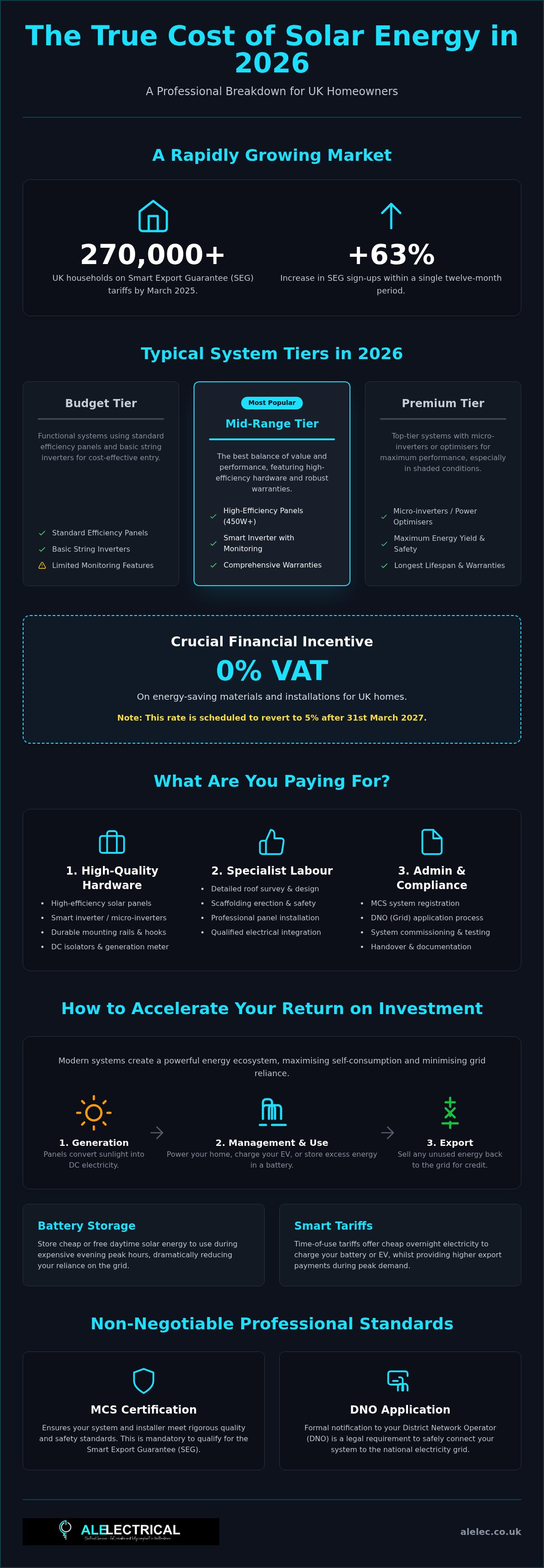
Did you know that by the end of March 2025, over 270,000 UK households had signed up for a Smart Export Guarantee tariff, marking a 63% increase in just twelve months? This surge reflects a growing desire for energy independence, yet it's understandable if you feel uncertain when researching the solar panel installation cost. It's normal to feel cautious about varying quotes or the technical complexity of grid applications whilst trying to ensure you're investing in high quality components that will protect your home for years to come.
This guide provides a transparent, professional breakdown of the true costs of solar energy in 2026. We'll move past the jargon to look at the genuine value of hardware, labour, and the smart tariffs that can significantly accelerate your return on investment. You'll discover how the latest battery storage options and the current 0% VAT rate on installations help you build a reliable energy ecosystem that's designed for the future. By the end of this article, you'll have a clear roadmap for your transition to renewable energy, grounded in the reliability and peace of mind you deserve from a seasoned specialist.
Table of Contents
The UK Solar Landscape: Average Installation Costs in 2026
The transition toward renewable energy has accelerated rapidly, with Solar power in the United Kingdom now reaching record levels of domestic adoption. As we move through 2026, the financial landscape for solar has matured, offering homeowners more predictable outcomes. Whilst hardware prices have stabilised, the focus has shifted from simply buying panels to investing in high-efficiency energy ecosystems. Understanding the typical 2026 cost range requires looking at the system as a whole, including the panels, the inverter, and the professional electrical integration required to keep your home safe.
The "price per watt" metric, once the gold standard for comparing quotes, has evolved. Modern panels in 2026 frequently exceed 450W efficiency, meaning you need fewer physical units on your roof to achieve the same power output as older systems. This efficiency reduces mounting hardware needs but requires more sophisticated inverters to manage the high energy density. When assessing the solar panel installation cost hertfordshire residents should consider how these tiers impact long term value:
Budget Tier: Utilises standard efficiency panels and basic string inverters. These are functional but may lack the advanced monitoring or individual panel optimisation found in higher tiers.
Mid-Range Tier: The most popular choice for 2026, featuring high-efficiency panels and robust warranties. This tier often includes smart monitoring to help you track your energy usage in real time.
Premium Tier: Incorporates top-of-the-line components like micro-inverters or power optimisers. These systems perform better in shaded conditions and typically offer the longest lifespan and best safety features.
System size also plays a major role in your final quote due to economies of scale. Much of the solar panel installation cost hertfordshire homeowners pay covers fixed expenses like scaffolding, roof surveys, and the labour of a qualified electrical team. Because these costs don't double just because you add more panels, larger systems often provide a better price per kilowatt-hour generated.
Current Market Trends Influencing Solar Prices
In 2026, global supply chains for silicon and lithium have become more resilient, keeping hardware costs steady. However, the demand for highly skilled electrical contractors has seen labour become a more significant portion of the total investment. This reflects the increasing complexity of modern systems, which often involve integrating solar with existing fuse boxes or full house rewires. It's also vital to remember that the 0% VAT rate on energy-saving materials remains in place until April 2027, providing a substantial saving for those who act before the rate reverts to 5%.
Residential vs Commercial Installation Costs
While domestic systems focus on offseting household bills, commercial solar panel installation operates on a different scale. Businesses often require specialised mounting for flat roofs and more complex scaffolding. Despite higher initial outlays, commercial systems frequently see a faster return on investment because businesses use the majority of their solar energy during daylight hours, directly reducing expensive peak-time grid reliance. For homeowners, achieving similar results often involves adding battery storage to bridge the gap between daytime generation and evening use.
Breaking Down the Quote: What Are You Paying For?
When you receive a quote for solar, it's easy to focus solely on the bottom line. However, a professional estimate is a complex balance of hardware, specialised labour, and administrative compliance. Understanding the specific components that make up the solar panel installation cost hertfordshire residents see helps ensure you aren't sacrificing safety for a lower price. Beyond the visible panels, your investment covers high-grade mounting rails, DC isolators, and the generation meter required to track your output accurately. Hidden factors like roof orientation and material also play a role. A south-facing roof might be the ideal, but east-west splits are increasingly popular for balancing energy generation throughout the day. If your home has slate tiles, the installation takes longer and requires specialised hooks, which is a detail often missed in generic online estimates.
Administrative fees are another essential part of the package. This includes the process of registering your system with the Microgeneration Certification Scheme (MCS) and handling the necessary applications with your local Distribution Network Operator (DNO). These steps are vital because following Ofgem's Smart Export Guarantee rules is the only way to ensure you can sell your surplus energy back to the grid. Skipping these formal applications can lead to legal issues and prevent you from accessing the financial returns that make solar so attractive in 2026.
The Inverter: The Heart of Your Solar System
Your panels capture sunlight, but the inverter converts it into usable electricity for your home. String inverters are the traditional choice, whilst micro-inverters offer better performance if your roof suffers from shading. In 2026, hybrid inverters have become the standard recommendation. These units are designed to manage both panels and battery storage, allowing you to add a battery later without replacing the entire unit. Whilst a cheaper inverter might save money today, high-quality models often come with 10-year warranties that match the lifespan of your other electrical components. Choosing the right inverter is the best way to manage your solar panel installation cost hertfordshire investment over the next decade.
Scaffolding and Structural Safety
Safety is a significant portion of any professional quote. Scaffolding is a legal requirement for working at height and provides a secure platform for our team to install your array safely. We also factor in a structural survey to confirm your roof can support the weight of the panels, particularly if you have older slate tiles which require more delicate handling than standard concrete tiles. To protect your investment, we recommend including bird proofing from the start. It's much more cost-effective to prevent nesting under your panels during the initial build than to clear debris years later. If you're planning other home improvements, you might consider a professional house rewire alongside your solar project to ensure your home's entire electrical system is ready for the future.
Calculating ROI: Smart Tariffs and the Battery Factor
The actual return on your investment in 2026 is determined by how much energy you keep within your own four walls. Whilst the initial solar panel installation cost hertfordshire residents pay is a primary consideration, the true profitability comes from avoiding expensive grid electricity. In the current market, energy suppliers offer Smart Export Guarantee (SEG) rates ranging from 5p to over 15p per kilowatt-hour. However, when you compare this to the cost of buying electricity from the grid, it's clear that self-consumption is your most powerful tool for reducing bills. Every unit of energy you generate and use yourself saves you significantly more than you'd earn by selling it back.
Modern time-of-use tariffs have changed the game for system profitability. These tariffs allow you to benefit from fluctuating energy prices throughout the day, rewarding you for being a flexible energy user. Load Shifting is the strategic use of stored energy during peak grid pricing. By using your own solar power when grid prices are at their highest, you maximise the value of every watt your roof generates. This behaviour ensures your system works hardest when the grid is most expensive, protecting your household budget from price spikes.
The Solar Battery Storage Multiplier
Adding home solar battery storage shifts the financial equation from simple generation to active energy management. While a battery increases the upfront solar panel installation cost hertfordshire homeowners face, it often helps achieve a payback period of between 6 and 9 years. In 2026, lithium iron phosphate (LiFePO4) batteries are the industry standard; they offer superior safety and a longer lifespan than older technologies. These systems allow you to charge from the grid at off-peak rates during the winter, ensuring you always have access to cheap power even when the sun isn't shining.
Future-Proofing with EV Integration
The synergy between solar arrays and electric vehicles is one of the most compelling reasons to upgrade your home’s electrical infrastructure. By integrating a home energy management system (HEMS), you can coordinate your solar generation, battery storage, and EV charging point to work in perfect harmony. This setup allows you to "fuel" your vehicle using surplus solar energy that would otherwise be exported for a lower rate. It turns your home into a private filling station, providing free mileage whilst reducing your reliance on public charging networks. This level of integration ensures your electrical system remains robust and capable as your household's energy demands evolve.
Professional Standards: Safety, Compliance, and Regulations
Whilst the initial solar panel installation cost hertfordshire residents see on a quote is significant, the true value of your system lies in its safety and long-term compliance. A professional installation is more than just fixing panels to a roof; it's a complex electrical project that must integrate seamlessly with your home's existing infrastructure. To access the Smart Export Guarantee (SEG) and receive payments for your surplus energy, your installer must be MCS certified. This certification acts as a mark of quality, ensuring that both the products used and the installation methods meet rigorous national standards. Without it, you'll find it nearly impossible to earn a return on the energy you export to the grid.
Grid compliance is another area where professional expertise is vital. Your installer must manage the notification process with the local Distribution Network Operator (DNO). For smaller systems, this usually involves a G98 notification, whilst larger arrays or those with high-capacity battery storage require a G99 application before work even begins. This ensures the local grid can handle the energy your system produces. If you're currently planning a house rewiring or a fuse box upgrade, it's the ideal time to integrate solar. Modern consumer units with built-in surge protection provide the robust foundation needed for a renewable energy system, whereas older boards might require significant modification.
Be cautious of "budget" quotes that seem too good to be true. These often save money by omitting vital safety components like DC isolators, AC breakers, or dedicated surge protection devices. These components are essential for protecting your home from electrical faults and lightning strikes. Choosing an established electrical contractor ensures these safety measures are never compromised for the sake of a lower price point.
The Importance of Electrical Testing
Before we begin any work, we often recommend an Electrical Installation Condition Report (EICR). This allows us to verify that your home's existing earthing system and wiring can safely support the additional load of a solar array and battery. Once the installation is complete, you should receive a suite of documents, including an installation certificate and a Part P building regulation notification. These documents are essential for your home insurance and will be required if you ever decide to sell your property.
Warranty and Long-Term Support
It's important to distinguish between product warranties and workmanship guarantees. Whilst panels often come with 25 year performance warranties, the workmanship guarantee covers the actual installation and wiring. Choosing a local specialist means you have a reliable point of contact for future support and annual health checks. These routine inspections ensure your system continues to operate at peak efficiency for decades to come. If you're ready to discuss a compliant, high-quality system for your home, you can request a professional solar survey from our team today.
Final Checklist: Getting the Best Value for Your Investment
Choosing the right partner for your project is about more than just finding the lowest solar panel installation cost hertfordshire market offers. A cheaper quote often hides compromises in hardware quality or skips the essential electrical safety checks we've discussed in previous sections. When you compare estimates, look closely at the specific model of panels and inverters being proposed. A vague description like "400W panels" without a brand name is a significant red flag. You should also verify that the quote includes all scaffolding, administrative fees, and the necessary bird proofing to protect your investment for the long term.
Ask your contractor who will actually be performing the work. You want the reassurance that a qualified electrician is managing the integration with your consumer unit, rather than a general roofing team with limited electrical experience. Be wary of "free solar" schemes where you don't own the hardware; these often prevent you from benefiting from the Smart Export Guarantee and can complicate future house sales. A professional, bespoke system designed for your specific energy needs provides a level of reliability and peace of mind that off-the-shelf solutions simply can't match. Understanding the local market and the typical solar panel installation cost hertfordshire homeowners encounter is just the first step in a successful transition to renewable power.
Preparing Your Home for the Survey
To get the most out of your professional consultation, it's helpful to have a few things ready. Locate your consumer unit and check if there's physical space for new breakers, as this helps us determine if a fuse box upgrade is necessary. If you're planning to install an inverter or battery in the loft, ensure the area is clear and accessible for our surveyor to inspect the roof structure. Finally, gather your energy bills from the last 12 months. This data allows us to accurately size your array and battery storage to maximise your self-consumption and return on investment.
Taking the Next Step with ALElectrical
At ALElectrical, we pride ourselves on being a dedicated team of specialists, not a faceless sales organisation. We don't use high-pressure tactics or "limited time" offers to rush your decision. Instead, we provide a steady, confident invitation to explore how renewable energy can work for your home. Our process starts with a free, no-obligation professional survey where we assess your home's unique requirements and design a system focused on safety and efficiency. If you're ready to secure your energy future, enquire about your solar and battery installation today and let our experts guide you through the process.
Securing Your Energy Independence for 2026 and Beyond
Navigating the transition to renewable energy is a significant step toward a more sustainable and cost-effective home. By now, you'll understand that the solar panel installation cost hertfordshire residents encounter is an investment in a managed energy ecosystem. Success depends on high-quality hardware, smart battery storage, and the expertise of a specialist who can integrate these systems with your existing consumer unit. It's about more than just panels on a roof; it's about ensuring your home is safe, compliant, and ready to benefit from the latest smart export tariffs.
Our team of fully qualified and insured professional electricians is here to help you move forward with confidence. We specialise in complex solar-battery and consumer unit integration, providing comprehensive safety and compliance certification as standard with every project. We're proud to act as your local guide, simplifying the technical process and delivering a system built to last. When you're ready to take the next step, you can get a free, no-obligation quote for your solar installation from ALElectrical. We look forward to helping you achieve lasting peace of mind and energy security.
Frequently Asked Questions
How much do solar panels cost for a 3-bedroom house in 2026?
A typical 4kW system for a three-bedroom home generally costs between £6,000 and £8,500 in 2026. If you choose to include battery storage, this range typically increases to between £10,000 and £14,000. These figures represent industry averages for high-quality components and professional labour. Whilst the initial solar panel installation cost hertfordshire residents or national homeowners pay is significant, the 0% VAT rate currently helps keep these systems accessible for most households.
Do I need planning permission for solar panel installation in the UK?
Most domestic solar installations fall under "permitted development" rights, meaning you don't usually need formal planning permission. However, exceptions apply if your home is a listed building or situated within a conservation area. New regulations introduced in August 2026 have further relaxed these rules, providing greater flexibility for homeowners. It's always best to verify with your local authority or a qualified installer before beginning any structural work on your property.
Can I install solar panels on a north-facing roof?
You can install panels on a north-facing roof, but the energy yield is significantly lower than south-facing alternatives. Typically, north-facing arrays produce around 40% to 50% less electricity, which extends the payback period of your investment. If your roof orientation isn't ideal, we often recommend exploring east-west configurations. These can provide a more consistent energy spread throughout the day, ensuring you maximise self-consumption even without a perfectly south-facing aspect.
How long does the average solar panel installation take to complete?
The physical installation of solar panels usually takes between one and two days for a standard residential property. This timeframe covers the mounting of the rails, panel placement, and the essential internal electrical wiring. You should also factor in additional time for scaffolding to be erected and dismantled. For systems involving complex battery storage or a fuse box upgrade, the process may require an extra day to ensure everything is fully tested and compliant.
Is it worth getting solar panels without a battery storage system?
Solar panels remain a viable investment without a battery, especially if your household uses most of its electricity during daylight hours. However, without storage, any surplus energy you generate is exported to the grid for a lower rate than the cost of buying it back later. Adding battery storage allows you to capture that energy for evening use. This significantly improves your return on investment and provides greater protection against fluctuating energy prices.
What is the difference between MCS certified and a standard electrician?
An MCS certified installer has met specific industry standards for renewable technology, which is a mandatory requirement for accessing the Smart Export Guarantee. While a standard electrician is qualified for general domestic work, an MCS specialist has undergone additional vetting for solar and battery systems. Choosing a contractor with a professional electrical background ensures your solar panel installation cost hertfordshire investment includes the highest standards of safety, compliance, and technical expertise.
How do I apply for the Smart Export Guarantee (SEG) in 2026?
To apply for the Smart Export Guarantee, you must first ensure your system is installed by an MCS certified professional. Once your array is commissioned, you'll receive a certificate which you must provide to your chosen energy supplier along with your smart meter data. Many suppliers now offer competitive SEG rates, with some fixed tariffs reaching 15p per kWh in 2026. This process ensures you are paid for every unit of surplus energy you export.
Will solar panels work during a power cut or grid failure?
Standard solar systems are designed to shut down during a power cut to prevent electricity from feeding back into the grid whilst engineers are working on it. This safety feature is known as "anti-islanding." If you require power during a grid failure, you'll need a specific battery storage setup with an "island mode" or a manual changeover switch. This allows your system to operate independently, providing essential power to your home's critical circuits during an outage.


Comments