
How to Calculate ROI on Solar Panels in the UK: A 2026 Step-by-Step Guide
Did you know that in late 2026, every kilowatt-hour of solar energy you consume at home is worth nearly double what you'd earn by selling it back to the grid? With the October price cap rising to 26.32p per kWh, the financial logic has shifted from simply selling power to saving power. It's completely natural to feel confused by varying SEG rates or how battery storage affects your bottom line. This guide will show you exactly how to calculate roi on solar panels uk, stripping away the complexity to reveal the true profitability of your home investment.
We'll provide a clear, manual formula that accounts for the current energy landscape and the vital 31 March 2027 VAT deadline. You'll learn how to balance your export earnings against your self-consumption savings whilst understanding how modern battery systems change the maths. By the end, you'll have the clarity and confidence to decide if solar is the right financial choice for your household.
Table of Contents
Identifying Your Total Upfront Investment and Direct Savings
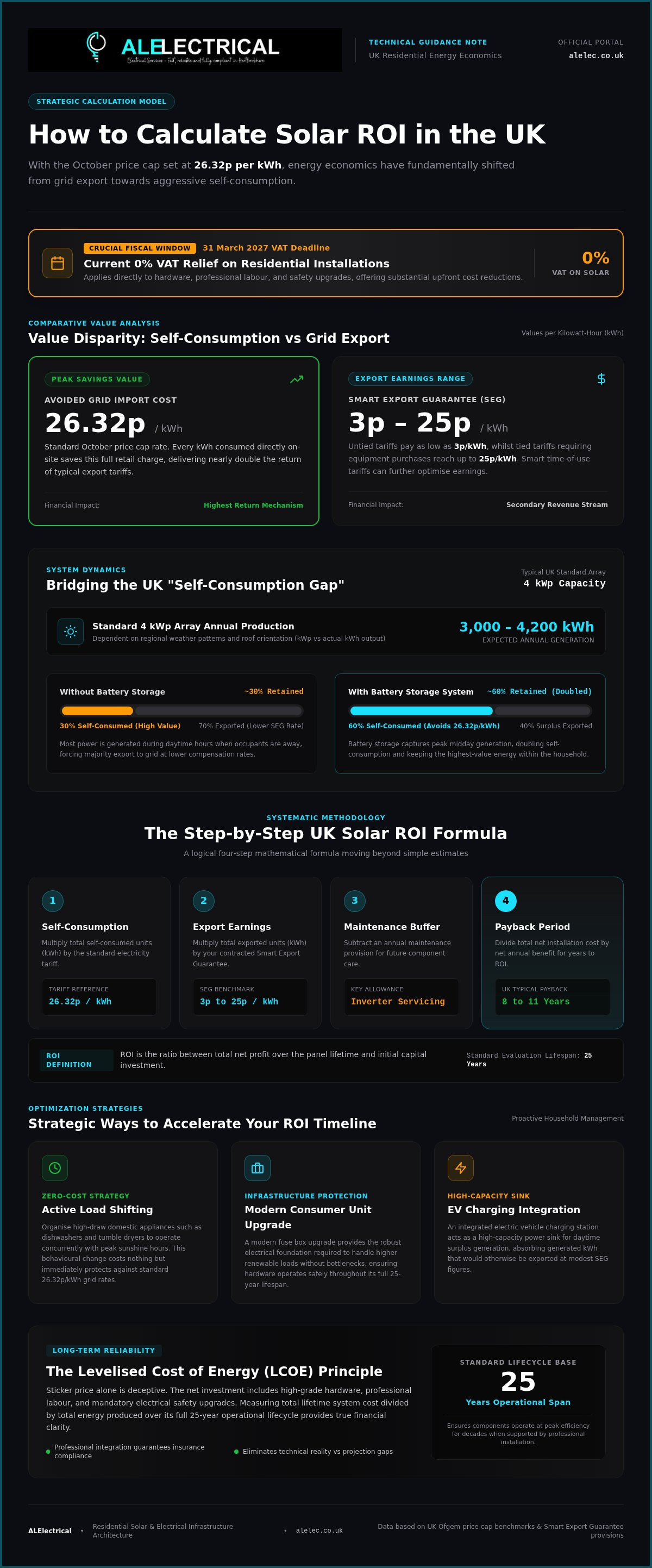
To understand how to calculate roi on solar panels uk, you must first define your net investment. This isn't just the price of the panels. It encompasses the entire integrated system, including high-grade hardware, professional labour, and necessary electrical safety upgrades. Currently, residential installations benefit from 0% VAT until 31 March 2027, which offers a significant upfront saving. However, looking at the Levelised Cost of Energy (LCOE) provides a truer picture than the sticker price alone. LCOE measures the total cost of the system divided by the total energy it will produce over its lifespan, usually 25 years. This approach ensures you account for long-term reliability and the peace of mind that comes with professional integration.
Choosing a professional partner is vital for insurance compliance and system longevity. A correctly installed system ensures the technical reality matches your financial projections. It protects your home whilst ensuring every component operates at peak efficiency for decades to come.
Estimating Annual Generation and Self-Consumption Rates
There's a distinct difference between a system's Peak Kilowatts (kWp) and its actual Kilowatt-hour (kWh) output. Whilst kWp represents potential capacity in lab conditions, your actual generation depends on regional weather and roof orientation. Understanding these variables is the first step in learning how to calculate roi on solar panels uk for your specific property. For context, solar energy generation in the UK typically yields between 3,000 and 4,200 kWh per year for a standard 4 kWp array.
Most UK homes face a "Self-Consumption Gap". Without a way to store energy, you might only use about 30% of what you generate, with the rest exported for a lower rate. Integrating home solar battery storage can often double this rate, keeping your free energy within the home where it's most valuable.
The Step-by-Step Formula for UK Solar ROI
Calculating your return doesn't have to be a mystery. To master how to calculate roi on solar panels uk, you need a logical, four-step approach that moves beyond simple estimates. This process ensures you account for both the energy you use and the energy you share with the grid.
Step 1: Multiply your self-consumed units by your electricity tariff (currently 26.32p/kWh).
Step 2: Multiply your exported units by your chosen SEG rate.
Step 3: Subtract an annual maintenance provision for future inverter servicing.
Step 4: Divide the total net cost by the annual benefit for the payback period.
Benchmark data on average solar panel costs and savings suggests a typical payback of 8 to 11 years for many UK households. This figure can improve significantly if you optimise your consumption patterns.
Factoring in the Smart Export Guarantee (SEG) and Bill Offsetting
Finding the best SEG rates is essential because they are not all created equal. In 2026, some suppliers offer up to 25p per kWh if you buy their equipment, whilst untied tariffs might pay as little as 3p. Smart tariffs, such as Agile or time-of-use plans, can further improve your ROI by allowing you to export when grid demand is highest.
Ultimately, ROI is the ratio between the net profit over the lifetime of the panels and the cost of the initial investment. If you're unsure how these variables apply to your home, a professional solar assessment can provide the precise data you need to proceed with confidence.
Strategic Ways to Shorten Your Solar ROI Timeline
Once you've mastered how to calculate roi on solar panels uk, the next step is to actively shorten that timeline. One of the most effective methods is "load shifting". By simply organising heavy appliance use, like running the dishwasher or tumble dryer, whilst the sun is shining, you maximise your free energy and avoid paying the standard grid rate. This behavioural change costs nothing but significantly boosts your annual savings.
Future-proofing your home is equally important for long-term profitability. Modern systems require a robust electrical foundation to handle the increased loads from renewable generation. Investing in fuse box upgrades ensures your system can safely manage solar and battery inputs without technical bottlenecks. A modern consumer unit provides the stability needed for your hardware to last its full 25-year lifespan.
The Impact of Solar Battery Storage and EV Integration
An EV charging installation acts as a high-capacity "sink" for surplus power, keeping your generated energy within your own ecosystem. Whilst the Smart Export Guarantee (SEG) provides a reliable secondary income stream, it's always more profitable to use the power yourself than to sell it back.
Adding a battery involves a higher upfront cost, but it can boost your self-consumption from 30% to roughly 80%. When you refine how to calculate roi on solar panels uk with a battery included, you'll often find that the increased daily savings outweigh the initial hardware expense. Don't overlook the "opportunity cost" of waiting; with energy prices remaining volatile, every month without solar is a month of missed savings. Professional integration ensures your technical setup matches these strategic financial goals.
Securing Your Energy Future
Understanding the mathematics of your home's energy production is the most reliable way to ensure your investment pays off. You now have the essential tools for how to calculate roi on solar panels uk, from identifying your net costs to factoring in the latest export rates. By combining strategic load shifting with modern battery integration, you can significantly reduce your payback period whilst protecting your home against future energy price volatility.
The key to achieving these projections lies in high-quality, professional installation. At ALElectrical, we provide expert solar and battery system integration with transparent, no-pressure advice on system sizing. Our team of qualified electricians is dedicated to helping you find the most efficient solution for your specific needs. Request a free, no-obligation solar quote from ALElectrical to begin your journey toward energy independence. We're here to help you turn these calculations into a sustainable, cost-effective reality for your home.
Frequently Asked Questions
How many years does it typically take for solar panels to pay for themselves in the UK?
Most UK homeowners find their system pays for itself within 8 to 11 years. This timeframe depends on local sunlight and your consumption patterns. Understanding these variables is central to how to calculate roi on solar panels uk effectively. Accurate installation and professional system sizing are vital to ensuring your technical reality matches these promising financial projections.
Does the Smart Export Guarantee (SEG) significantly affect solar ROI?
Yes, the SEG provides a secondary revenue stream that shortens your payback period. Whilst the highest rates can reach 25p per kWh, many standard tariffs offer between 12p and 15p. When you're looking at how to calculate roi on solar panels uk, comparing these rates is essential. Choosing a competitive tariff ensures your surplus energy generates a consistent financial return.
Is it worth adding a battery storage system to my solar panels for better ROI?
Adding a battery increases your upfront investment but often results in a better long-term ROI. By storing surplus power, you can increase your self-consumption from roughly 30% to 80%. This reduces your reliance on expensive grid electricity, which currently costs approximately 26.32p per kWh. It's a strategic way to maximise the value and safety of every unit you generate.
Will solar panels increase the resale value of my UK home?
Solar panels generally increase the resale value of UK homes by improving their energy efficiency and EPC ratings. A professionally integrated system suggests a well-maintained property, which is increasingly attractive to modern buyers. This can make your home more desirable, potentially increasing its market value whilst providing immediate and long-term energy savings for the next owner.


Comments