_.jpg)
Electric Repair vs. Electrical Upgrades: A Homeowner’s Comparison Guide
Is that flickering kitchen light a five-minute fix, or a warning sign that your home's wiring is reaching its limit? It's completely natural to feel a sense of dread when a socket sparks or a breaker trips. You want your family to be safe. However, you also don't want to be talked into a costly, full-scale renovation if a simple electric repair is all that's actually required. Conflicting advice from different tradespeople often makes the situation even more stressful, leaving you unsure whether you're overspending or under-protecting your property.
We understand that transparency and reliability are what matter most when it comes to your home's power. This guide provides the clarity you've been looking for by breaking down the differences between quick fixes and comprehensive system improvements. You'll discover how to identify the red flags of an ageing electrical setup and learn why a professional inspection is your best tool for making an informed decision. We'll also look at how modern demands, like EV chargers, might change your requirements. By the end, you'll know exactly how to ensure a safe home environment without facing unexpected financial surprises.
Table of Contents
What is an Electric Repair? Understanding the Scope of Minor Fixes
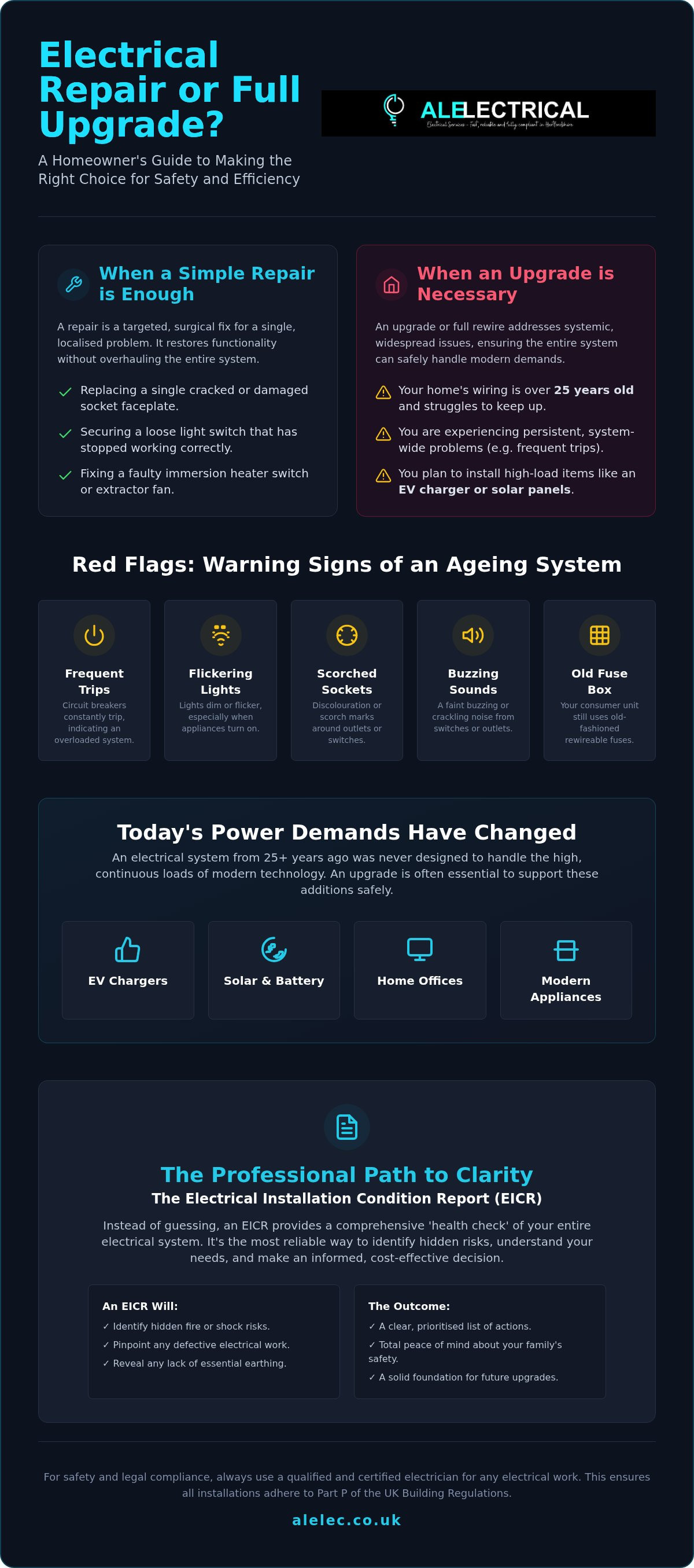
When we talk about an electric repair, we are referring to a surgical strike on a specific problem within your home. Unlike a full-scale renovation or a complete rewire, a repair is a targeted fix designed to restore functionality to a single component. This might involve replacing a cracked socket faceplate, securing a loose light switch, or addressing a faulty immersion heater switch that has stopped heating your water. These tasks are essential for the daily rhythm of your home, but they focus on the symptoms rather than the entire infrastructure.
Understanding the fundamental electrical wiring standards is key to recognising why these small fixes matter. Whilst a single flickering bulb might seem like a nuisance, it can sometimes indicate a loose connection that generates heat. By addressing these issues early, you prevent minor inconveniences from escalating into safety hazards. It is also a matter of protecting your investment. Most home insurance providers require that work is carried out by a qualified professional to maintain the validity of your policy. Attempting a "quick fix" yourself can lead to complications if you ever need to make a claim.
Typical Minor Electrical Repairs in Modern Homes
Modern living puts a lot of pressure on our electrical systems. We often see homeowners needing assistance with specific, high-use areas. Common tasks include:
Socket and Switch Maintenance: Replacing damaged or scorched faceplates and light switches to ensure a secure connection.
Ventilation Systems: Installing or repairing extractor fans in kitchens and bathrooms to prevent moisture build-up.
Safety Devices: Fixing hardwired smoke alarms and security lighting that has become intermittent or unresponsive.
For more detail on how these tasks align with current UK regulations, you can refer to our Professional Electrical Repair guide. This resource explains the importance of compliance and what you should expect from a certified technician during a visit.
When a Fix is Just a Temporary Band-Aid
It is vital to distinguish between a genuine electric repair and a temporary patch for a much larger issue. If you find yourself repeatedly resetting a circuit breaker or changing the same fuse every few weeks, you aren't dealing with a simple repair. You're dealing with a symptom. In older properties, persistent minor faults often point to a system that can no longer handle the load of modern appliances. Ignoring these signs is risky. A professional can help you determine if a component simply reached the end of its life or if your home’s wiring is struggling to keep up with your family’s energy demands.
Repairing vs. Upgrading: Which Path is Right for Your Home?
Choosing between a one-off electric repair and a system upgrade is often a question of longevity and safety. If your home's wiring is over 25 years old, it was designed for a completely different era. Decades ago, households didn't have multiple laptops, smart TVs, and high-powered kitchen appliances running simultaneously. The 25-year rule is a standard industry benchmark; once your installation hits this milestone, the insulation on cables can become brittle, and the overall capacity often struggles to keep up with modern life.
Symptom vs. Systemic Issue: How to Tell
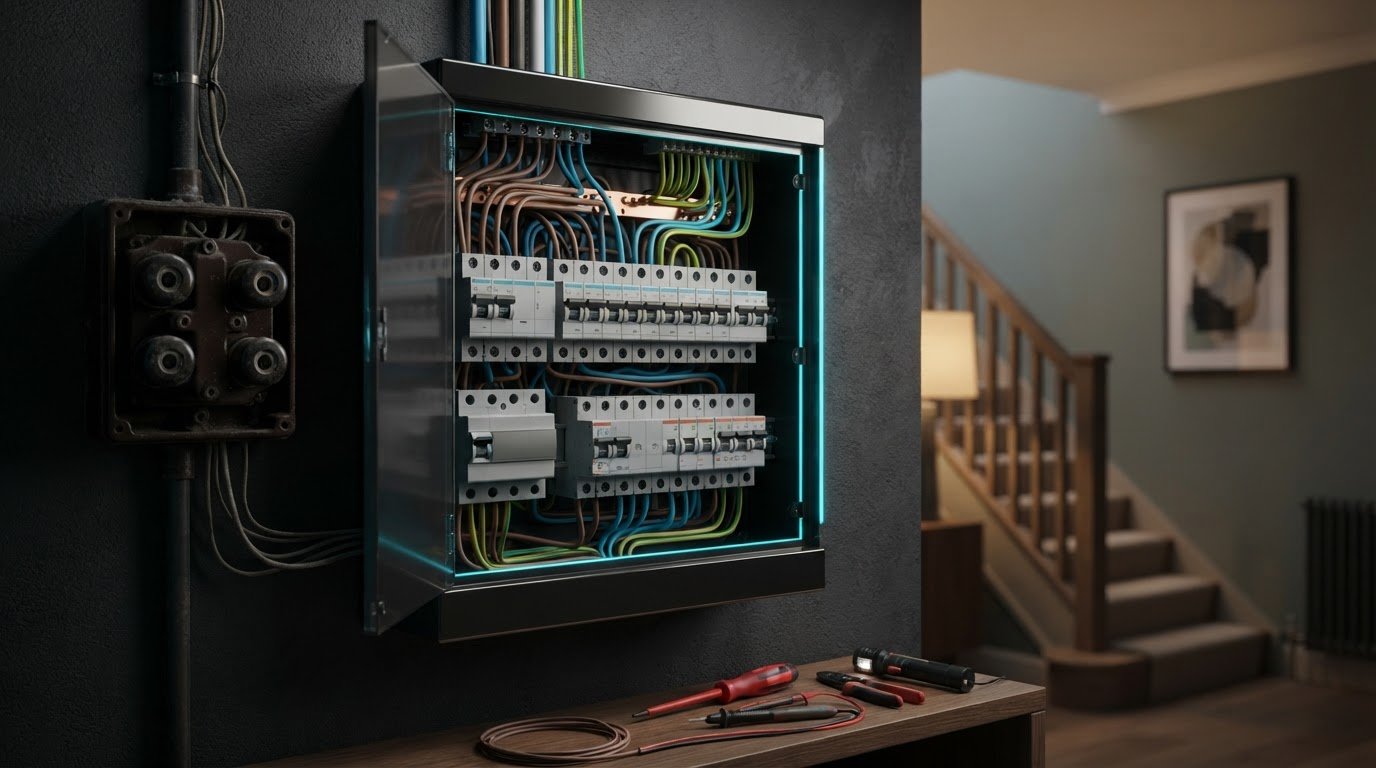
A single faulty socket or a broken light switch is usually a localised issue that can be resolved quickly. However, if you notice lights flickering in multiple rooms or hear buzzing sounds near your fuse box, you're likely facing a systemic failure. Your consumer unit acts as the brain of your home. If it's an old-fashioned box with re-wireable fuses, it lacks the sensitive safety features needed to protect your family from modern electrical surges. In these cases, you might need to stop patching the problem and consider a house rewire to ensure your property remains a safe environment.
Our energy needs have shifted dramatically. Installing an EV charger, a home office, or solar panels requires a robust electrical foundation. An older system might require constant maintenance just to stay operational under these new, heavy loads, making an upgrade the more logical choice for a future-proofed home.
The Financial Logic of Electrical Upgrades
While an electric repair has a lower upfront cost, the "repair ceiling" is a real financial threshold. This is the point where the cumulative cost of multiple call-outs and minor fixes starts to approach the price of a significant upgrade, such as a new metal consumer unit. Upgrading your system provides a better return on investment by lowering home insurance premiums, as insurers view modern, compliant wiring as a much lower fire risk. It also adds tangible value to your property. Consider these benefits of choosing an upgrade over repeated repairs:
Reduced risk of electrical fires and damaging power surges.
Full compliance with the latest UK building regulations and safety standards.
Increased capacity for future technologies like battery storage and heat pumps.
Enhanced property appeal and peace of mind for potential buyers.
If you're unsure about the state of your current setup, we can provide expert guidance on your electrical options to help you plan your maintenance effectively.
The Risks of DIY Electric Repair and Why Professionalism Matters
Many homeowners feel a surge of confidence after watching a quick online tutorial. It's tempting to think that a simple electric repair is just a matter of matching wire colours and tightening a few screws. However, the reality of domestic electricity is far more complex than what a five-minute video can show. In the UK, the legal framework known as Part P of the Building Regulations exists specifically to keep you safe. It dictates that most electrical work in "special locations" like bathrooms and kitchens must be notified to local building control or carried out by a registered professional who can self-certify the work.
Professionalism isn't just about making a light bulb glow. It's about ensuring that if a fault occurs, your system will react correctly to prevent a fire or a fatal shock. An amateur might get a socket to work, but they lack the calibrated testing equipment required to verify circuit integrity. Without measuring earth loop impedance or insulation resistance, there's no way to know if the circuit is actually safe under load. A light that turns on is not proof of a safe installation.
Hidden Dangers of Amateur Electrical Work
The most significant risks of DIY work are often invisible to the untrained eye. Inadequate earthing is a common oversight that leaves your family vulnerable to electric shocks if a metal appliance becomes live. Poorly tightened connections are equally dangerous; they can lead to arcing, which generates intense heat and is a leading cause of domestic house fires. Common DIY blunders also include using incorrectly rated cables for high-draw appliances or failing to provide adequate strain relief at terminals. Beyond the physical risks, uncertified work can have serious financial consequences. Most home insurance providers will refuse to pay out for fire damage if they discover the cause was a non-compliant electric repair carried out by an unqualified person.
Regulatory Compliance and BS 7671 Standards
Every professional electrician in the UK works to BS 7671, also known as the IET Wiring Regulations. This is the national standard for electrical installations, covering everything from wire types to the placement of protective devices. These rules are updated regularly to reflect new safety technologies and changing household energy demands. When you hire a professional, you aren't just paying for their time; you're paying for their adherence to these rigorous standards.
Upon completion of any minor work, a qualified technician will issue a Minor Works Certificate. This document is your proof of compliance and is vital when you come to sell your home or if you need to prove the safety of your system to an insurer. At ALElectrical, we ensure every job meets these national safety benchmarks, providing you with the documentation and peace of mind that your home's infrastructure is both legal and secure. We prioritise safety and compliance in every task, from a single socket replacement to a full fuse box upgrade.
How to Organise and Prioritise Your Electrical Maintenance
Effective home management requires a logical approach to property upkeep. While you might be tempted to delay a seemingly minor electric repair, understanding which issues pose a genuine threat is essential for your family's safety. We recommend categorising your electrical needs into three clear tiers: urgent safety risks, preventative maintenance, and aesthetic upgrades. By grouping non-urgent tasks together, you can significantly reduce the cost of professional labour. A single visit to address multiple sockets, switches, or light fittings is far more economical than several separate call-outs, preventing the need for a reactive electric repair later down the line.
The Homeowner’s Electrical Safety Checklist
You don't need technical expertise to maintain a basic level of safety. Establishing a few simple habits can identify problems before they become dangerous. We suggest focusing on these three areas:
Monthly RCD testing: This is a vital habit. Pressing the "test" button on your consumer unit ensures the safety switch is functional. It’s a five-second task that could save a life.
Visual inspections: Regularly check for cracked faceplates, yellowing plastic, or cables that feel hot to the touch. These are early signs of wear.
Warning signs: Never ignore a persistent fishy smell or the scent of burning plastic. These are often signs of arcing or overheating within a wall cavity and require professional attention to prevent a fire.
Understanding EICR and Routine Inspections
An Electrical Installation Condition Report (EICR) provides a comprehensive overview of your system’s health. It’s the most thorough "health check" available, involving technical testing of the circuits hidden behind your walls. The report uses specific codes to help you prioritise any necessary work:
C1 (Danger present): Risk of injury. Immediate action is required to make the installation safe.
C2 (Potentially dangerous): Urgent action is required to remove potential risks.
C3 (Improvement recommended): This isn’t a failure, but it suggests your system could be safer or more efficient.
For most homeowners, a professional inspection every ten years is the standard recommendation. However, if you are a landlord, UK law mandates a new report every five years or at the start of a new tenancy. If you're ready to secure your home's future, you can book a professional electrical inspection to get a clear picture of your system's current state and ensure total compliance.
Professional Electrical Maintenance: Moving Beyond Reactive Repairs
Modern homeownership requires a shift in how we view our property's infrastructure. For many, an electric repair is seen as a one-off event, a chore to be ticked off only when a socket fails or a light stops working. However, treating your electrical system as a static entity can lead to missed opportunities for efficiency and safety. Moving beyond reactive fixes means looking at your home as an evolving environment that needs to support increasingly sophisticated technology. By adopting a proactive maintenance strategy, you ensure that your wiring doesn't just "work" but actually thrives under the demands of 21st-century living.
Future-Proofing with Solar and EV Solutions
The transition to renewable energy and electric transport starts at your consumer unit. If you are planning to install solar panels or battery storage, your existing system must be robust enough to handle two-way energy flow. A fuse box upgrade is often the essential foundation for these technologies, providing the modern safety components required for energy independence. Without a healthy electrical backbone, even the most advanced solar array cannot perform at its peak efficiency.
Similarly, preparing for an EV charger installation involves more than just mounting a box on the wall. These units represent a significant, sustained load on your domestic supply. Ensuring your home's wiring and protective devices are up to the task prevents nuisance tripping and protects your vehicle's sensitive electronics. When you prioritise high-quality maintenance, you aren't just fixing a problem; you are building a platform that supports high-load appliances and green technologies for years to come.
Why ALElectrical is Your Partner in Home Safety
Choosing the right professional to manage your home's power is a matter of trust. We believe that clarity and transparency should be at the heart of every project, which is why we provide free, no-obligation quotes for all our work. Whether you need a simple electric repair or are looking to undertake a full house rewire, we approach every task with the same commitment to high standards and community-focused service. Our team brings a wide range of expertise to your doorstep, from solar-battery integration to complex EICR inspections.
Working with a multi-skilled specialist means you get a holistic view of your home's health. We don't just look at the faulty switch; we consider how that switch fits into your wider electrical strategy. This comprehensive approach helps you avoid the "repair ceiling" discussed earlier, ensuring your budget is always spent on the most effective solutions. If you're ready to move away from stressful, reactive fixes and toward a safe, future-proofed home environment, we invite you to reach out for a professional assessment today.
Securing Your Home’s Electrical Future
Deciding between a minor fix and a major upgrade doesn't have to be a source of stress. By understanding the 25-year rule and the specific safety codes within an EICR, you can make informed choices that protect both your family and your property's value. Whether you're addressing a single flickering light or preparing your home for energy independence with solar and EV charging, the goal is always a safe, reliable environment. Moving beyond reactive maintenance allows you to build a system that meets today's high-load demands while staying fully compliant with BS 7671 standards.
At ALElectrical, we pride ourselves on being transparent partners for our community. Our qualified experts specialise in everything from routine safety inspections to complex renewable integrations, all delivered with clear pricing and no high-pressure sales tactics. If you're ready to gain clarity on the state of your wiring, request a free, no-obligation quote for your electric repair from ALElectrical. We're here to help you navigate your options and ensure your home remains a secure place for years to come.
Frequently Asked Questions
How much does a typical electric repair cost in the UK?
The cost of an electric repair varies depending on the complexity of the fault and the time required for accurate diagnosis. Most professional electricians charge an initial fee that covers the first hour of labour, which is often sufficient for minor tasks like replacing a single socket or light switch. If a fault is hidden within the walls, the diagnostic time may increase the overall investment required to ensure your home remains safe.
Can I carry out small electric repairs myself if I am confident?
While you might feel confident with basic tools, carrying out an electric repair yourself is generally discouraged due to significant safety and legal risks. In the UK, Part P of the Building Regulations requires most electrical work to be certified by a registered professional. DIY attempts often lack the necessary testing to ensure the circuit is safe under load. Incorrectly installed components can lead to house fires or invalidate your home insurance policy.
How do I know if I need a full rewire or just a simple repair?
Determining the difference between a minor fault and a systemic failure usually depends on the age of your installation. If your wiring is over 25 years old or you experience frequent circuit breaker trips across multiple rooms, a full rewire is likely necessary. A simple repair is appropriate for isolated issues, such as one broken switch. A professional assessment will provide clarity on whether your system can still safely handle modern power demands.
What is an EICR and do I need one before getting a repair?
An Electrical Installation Condition Report (EICR) is a comprehensive safety inspection that assesses the health of your entire electrical system. While you don't always need one before a minor repair, it is the most reliable way to identify hidden faults that a simple visual check might miss. We recommend an EICR every ten years for homeowners to ensure that small maintenance tasks aren't just masking deeper, more dangerous wiring issues.
Why do my lights flicker even after I have replaced the bulb?
Persistent flickering often indicates a loose connection or a fault within the circuit wiring rather than a problem with the bulb itself. This can be caused by arcing at the light fitting or a failing switch. It might also suggest that your home’s electrical system is struggling to maintain a consistent voltage when high-draw appliances are running. Because flickering can be a precursor to a fire, it's vital to have a professional investigate the underlying cause.
Is a fuse box upgrade considered a repair or an improvement?
A fuse box upgrade is considered a significant safety improvement rather than a simple repair. Modern consumer units include sensitive RCD and AFCI protection that old-fashioned fuse boxes lack. These devices are designed to disconnect the power in milliseconds if a fault is detected, providing a level of protection that simple maintenance cannot match. Upgrading your fuse box also ensures your home meets current BS 7671 standards and prepares it for future technologies.
What should I do if I smell burning near a socket or switch?
If you smell burning plastic or a fishy odour near a socket, you should immediately turn off the power at the main consumer unit. Do not attempt to use the socket or investigate the wiring yourself. This scent is a critical warning sign of arcing or overheating components, which can quickly lead to an electrical fire. Once the power is safely isolated, contact a qualified specialist to perform an urgent electric repair and safety check.
How long does a standard electrical repair usually take to complete?
Most minor electrical repairs, such as replacing a faulty socket or a light switch, can be completed within one to two hours. However, the total time often depends on the diagnostic process. Finding the root cause of an intermittent fault or a tripping breaker can sometimes take longer than the physical fix itself. A professional will typically provide a clear estimate of the required time once they have assessed the specific issue in your home.


Comments