_.jpg)
Emergency Lighting Installation: The Complete 2026 Commercial Reference Guide
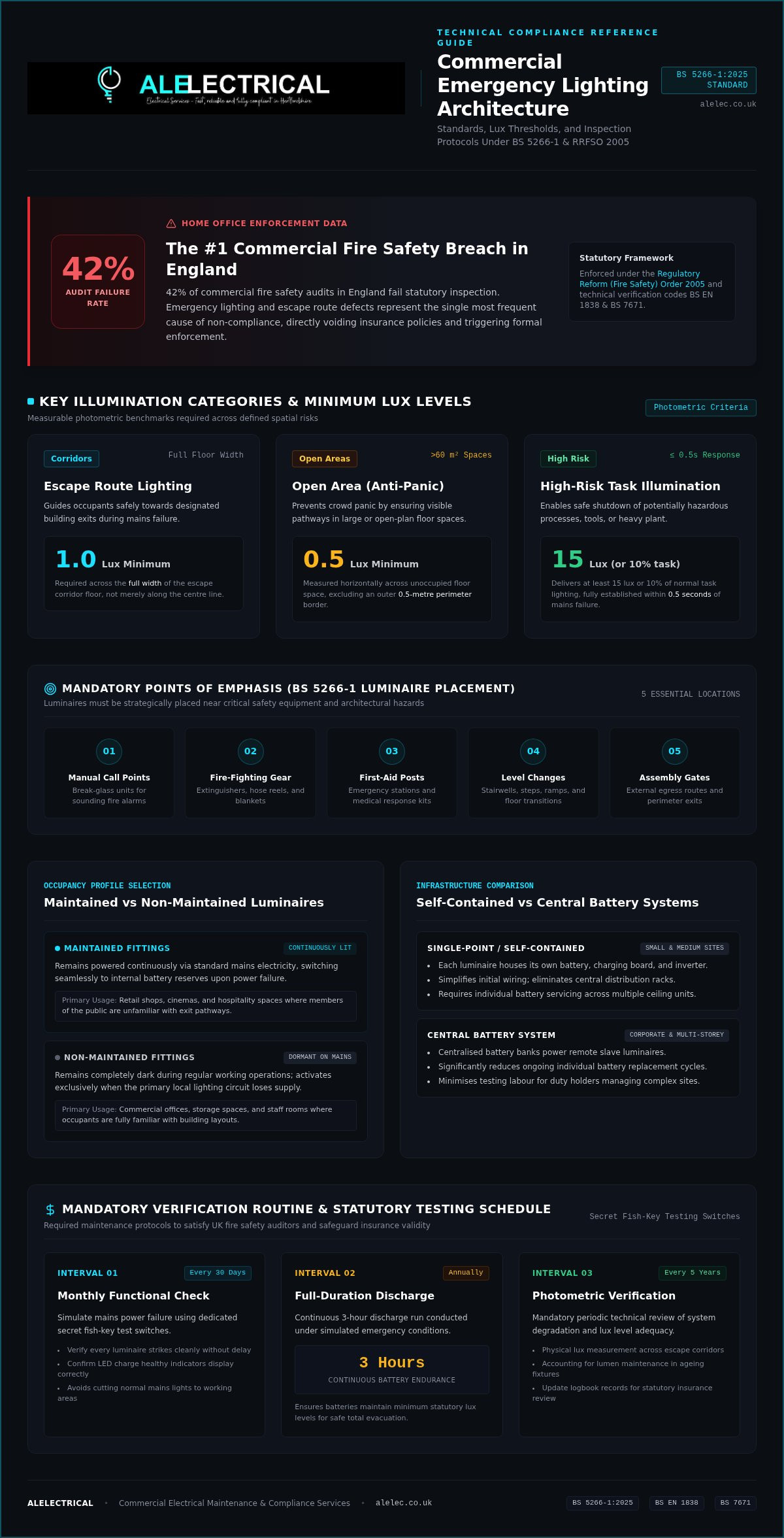
According to Home Office enforcement data, 42% of commercial fire safety audits in England fail, with emergency lighting and escape route defects representing the single most common breach. True compliance isn't just about mounting a few battery-backed luminaires above exit doors; it requires seamless architectural integration. If you're worried about passing statutory fire inspections or confused by maintained versus non-maintained fittings, you aren't alone. A compliant emergency lighting installation protects building occupants while safeguarding your insurance validity.
In this guide, you'll master current UK emergency lighting standards, system categories, and testing obligations to ensure complete safety across your premises. We'll walk through the essential BS 5266-1:2025 updates and show you exactly what's required for clear, reliable escape illumination.
Table of Contents
UK Emergency Lighting Regulations and BS 5266-1 Compliance Standards
When normal mains electricity fails, emergency lighting provides instant, automated illumination to ensure safe evacuation. Under the Regulatory Reform (Fire Safety) Order 2005, commercial premises must maintain clear escape pathways at all times. A standard commercial fit-out cannot treat these units as an afterthought; a compliant emergency lighting installation is a primary statutory defence against enforcement action.
Technical performance benchmarks are governed by BS 5266-1 alongside BS EN 1838. Rather than merely offering visibility, modern emergency lighting systems must meet rigorous, measurable lux levels at floor level across defined escape corridors.
Key Illumination Categories Under British Standards
British Standards categorize emergency illumination into three operational groups, each addressing distinct spatial risks:
Escape Route Lighting: Directs occupants safely out of the building. Current standards require a minimum of 1 lux across the full width of the corridor floor, not just along the centre line.
Open Area (Anti-Panic) Lighting: Reduces panic in areas exceeding 60 m² by maintaining at least 0.5 lux across floor space, excluding a 0.5-metre perimeter border.
High-Risk Task Illumination: Supplies higher light levels, at least 15 lux or 10% of standard task lighting, within 0.5 seconds to allow safe shutdown of hazardous equipment or machinery.
In addition to corridor routes, emergency luminaires must highlight specific points of emphasis. You must position fittings near manual call points, fire-fighting equipment, first-aid posts, and external assembly gates to keep key safety assets clearly visible during a power cut.
Selecting the Right Emergency Lighting System for Your Facility
Selecting the appropriate architecture for your emergency lighting installation depends on building size, layout, and operational demands. Smaller commercial units generally favour self-contained single-point fittings. Each fixture houses its own battery, charger, and inverter, simplifying initial wiring and eliminating central distribution racks. Conversely, extensive corporate sites or multi-storey buildings benefit from central battery systems. While equipment setup requires careful planning, centralising battery banks cuts ongoing replacement cycles and helps duty holders manage statutory UK workplace fire safety responsibilities with far less labour.
Maintained versus Non-Maintained Emergency Luminaires
Building occupancy profiles dictate how your fittings should behave during standard working hours:
Maintained Luminaires: These units remain continuously lit on mains power and switch to battery backup if power drops out. They're standard in retail shops, cinemas, and hospitality spaces where members of the public are unfamiliar with exit routes.
Non-Maintained Luminaires: Designed to remain unlit during daily operations, these activate solely when the primary lighting circuit fails. They suit familiar workplaces like offices, commercial storage areas, and staff rooms.
Modern commercial setups almost universally employ LED luminaires. Modern LED fittings consume minimal parasitic power while on standby and deliver exceptional lumen maintenance over lengthy duty cycles. Factoring fixture types into your wider commercial electrical maintenance strategy ensures emergency circuits switch seamlessly without compromising routine energy efficiency.
Professional Installation, Commissioning, and Ongoing Verification
Strategic placement begins with mapping luminaire positions against architectural hazards, stairs, and exit paths. Qualified contractors integrate dedicated secret key switches into local lighting circuits. This allows your team to simulate mains failure safely during routine inspections without plunging working areas into darkness. Aligning an emergency lighting installation with routine electrical maintenance services keeps systems certified under BS 7671 and aligned with official HSE guidance on lighting at work.
Testing Regimens and Statutory Logbook Documentation
Commissioning marks the start of your legal duty, not the end. To satisfy UK fire inspectors, duty holders must conduct structured verification routines:
Monthly Functional Tests: A quick simulated mains failure via fish-key switches to confirm every fitting strikes cleanly and charge indicators show healthy operation.
Annual Full-Duration Discharge: A comprehensive continuous three-hour test to confirm battery endurance remains capable of supporting safe evacuation.
Contemporaneous Logbook Records: Documented outcomes of all monthly checks, annual services, faults, and remedial work signed off in your building safety logbook.
Following final sign-off, your commercial electrical contractor issues formal completion certification alongside as-fitted luminaire layouts. Keeping this documentation up to date provides concrete evidence of compliance during safety audits, protecting building occupants and keeping insurance policies valid.
Securing Lasting Safety Across Your Commercial Premises
Maintaining compliant emergency illumination isn't just about passing fire audits; it's about protecting every person inside your building. By aligning system choices with occupancy profiles, illuminating full-width escape corridors, and keeping testing logbooks up to date, you safeguard both lives and insurance validity.
Executing a dependable emergency lighting installation requires technical precision and transparent documentation. Working with certified commercial electrical contractors ensures your system design, commissioning certificates, and ongoing maintenance meet strict BS 5266-1 standards without disrupting everyday business operations. When you're ready to ensure total protection for your building, book a professional emergency lighting consultation with ALElectrical. With the right certified support in place, you can move forward with complete confidence in your site's ongoing safety.
Frequently Asked Questions
How often must commercial emergency lighting be tested under UK law?
Commercial emergency lighting requires two statutory tests under the Regulatory Reform (Fire Safety) Order: a monthly functional check and an annual full-duration test. The monthly test briefly simulates mains loss via a test switch to confirm luminaires ignite. The annual service involves a continuous three-hour discharge test to verify battery endurance, with all outcomes recorded in your safety logbook.
What is the difference between maintained and non-maintained emergency lighting?
Maintained luminaires remain lit continuously alongside your standard lighting and stay on during a power cut. Non-maintained luminaires remain off during regular working hours, activating solely when primary electrical circuits fail. Maintained units suit retail and public assembly spaces, whereas non-maintained fittings work effectively in familiar workplace settings like private offices or staff storage areas.
Is emergency lighting installation mandatory for all commercial buildings?
Yes, virtually all UK commercial premises legally require a compliant emergency lighting installation under national fire safety legislation. If mains power fails, occupants must have clear, automated visibility to navigate exit routes safely. Your building fire risk assessment dictates specific layout needs, requiring illuminated pathways across corridors, stairwells, changes in floor level, and external assembly areas.
How long must emergency lighting stay illuminated during a power failure?
In most commercial properties, emergency lighting must maintain continuous illumination for a minimum of three hours. This standard duration, codified in BS 5266-1, provides ample time for safe evacuation. It also ensures that sufficient battery capacity remains should early re-occupation occur or emergency services require interior visibility during an extended power cut.


Comments