_.jpg)
Comprehensive Electrical Maintenance Services: A 2026 Guide to Safety and Compliance
What if scheduled upkeep isn't an annoying operational expense, but the single best investment against sudden, catastrophic damage? Waiting for a tripping switch or a scorched board before booking professional electrical maintenance services often transforms a simple adjustment into an expensive emergency.
Between confusing legal obligations surrounding EICRs and the quiet dread of electrical fires, keeping your property secure can easily feel overwhelming. You simply want reliable peace of mind, knowing your wiring is safe, your building satisfies insurance standards, and your occupants are protected. In this guide, you will discover how planned maintenance shields your property, guarantees compliance, and prevents severe repair bills. We'll explore what comprehensive servicing entails, how modern consumer unit upgrades reinforce safety, and how often your system truly needs testing.
Table of Contents
The Core Components of Professional Electrical Maintenance Services
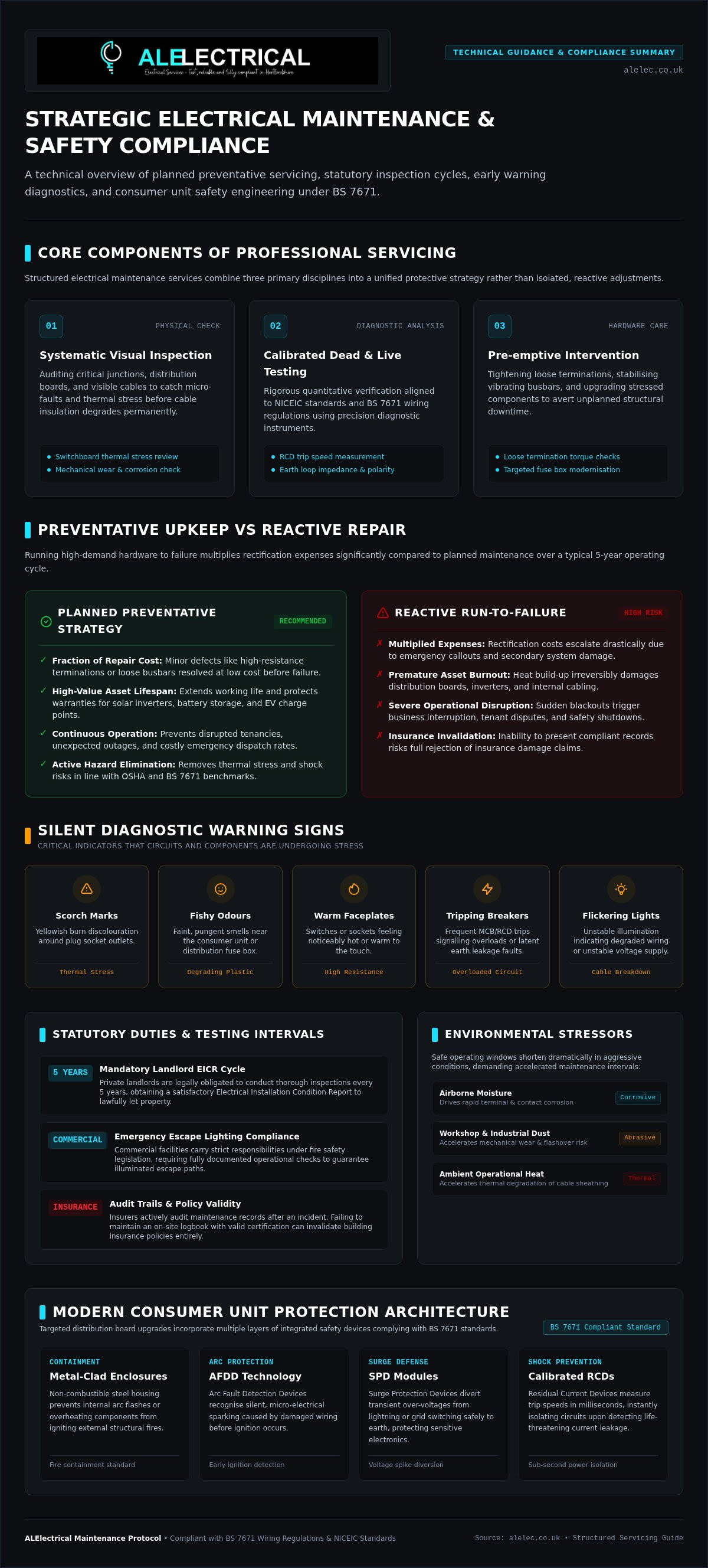
Professional electrical maintenance is far more than an ad-hoc checklist of isolated fixes. Instead, structured electrical maintenance services unite systematic visual inspections, calibrated dead and live testing, and pre-emptive component replacements into a coherent protective plan. Rather than waiting for an overload to trigger an outage, adopting proven preventive maintenance strategies keeps wiring infrastructure resilient by catching micro-faults before heat build-up permanently degrades cable insulation.
During a comprehensive site visit, certified specialists inspect every critical junction within your installation. They verify residual current device (RCD) trip speeds, measure earth loop impedance, test socket polarity, and examine switchboard terminals for thermal stress. Conducting this testing to NICEIC-aligned standards guarantees that work adheres strictly to current BS 7671 wiring regulations. If older distribution boards struggle with modern demands, planning targeted fuse box upgrades alongside routine servicing eliminates vulnerabilities without unplanned downtime.
Establishing an Effective Electrical Servicing Schedule
Optimal servicing intervals depend on operational intensity and physical environment. High-footfall commercial environments require frequent verification to handle continuous operational loads, whilst domestic settings can follow longer inspection cycles. Environmental stressors, including airborne moisture, workshop dust, and ambient heat, also accelerate mechanical wear and contact corrosion, shortening safe operating windows.
To support your position with insurers, maintain a structured electrical logbook on site. Documenting test results, remedial repairs, and equipment upgrades creates an irrefutable audit trail that protects asset value and confirms legal compliance.
Preventative Maintenance vs. Reactive Electrical Repair
Waiting for components to fail creates expensive operational downtime, disrupted tenancies, and severe secondary damage. Running high-demand hardware to failure multiplies rectification expenses significantly compared to planned upkeep. Scheduled electrical maintenance services protect high-value assets, including solar inverters, battery storage setups, and EV charging points, extending their operating life and preserving manufacturer warranties. In line with benchmark workplace principles found in OSHA electrical safety standards, preventative intervention actively eliminates thermal and shock hazards before they endanger personnel.
Over a typical five-year cycle, planned preventative servicing remains the most sensible approach to controlling property overheads. Fixing minor defects, such as vibrating busbars or high-resistance terminations, costs a fraction of an unscheduled replacement. For long-term peace of mind, arranging professional electrical maintenance provides transparent cost control whilst keeping critical infrastructure running at peak efficiency.
Recognising Early Warning Signs in Your Electrical System
Faults rarely manifest overnight without giving subtle warning cues first. Silent symptoms include yellowish scorch discolouration around socket outlets, faint fishy odours near the fuse box, or faceplates that feel abnormally warm. Likewise, frequently tripping breakers or flickering lights aren't isolated quirks; they often signal deteriorated cabling or overloaded circuits struggling under modern power demands. Should you notice these red flags appearing across several rooms, consult our practical guide to the warning signs your home needs a rewire to determine if your wiring needs remedial restoration.
Compliance, Legal Obligations, and Safety Standards
Legal compliance is the cornerstone of responsible property ownership. Private landlords must ensure installations are inspected at least every five years, securing a satisfactory Electrical Installation Condition Report to lawfully let a property. Commercial premises carry parallel duties under fire safety legislation, requiring documented operational checks on emergency escape lighting to safeguard evacuation paths. Modern industry benchmarks, such as the NFPA 70B standard for electrical equipment maintenance, increasingly influence insurer requirements for comprehensive risk assessments and defined testing intervals.
Insurers regularly audit safety paperwork following an incident. Failing to produce valid certification can invalidate building insurance policies entirely. Routine electrical maintenance services also ensure that modern safety technology functions reliably during a surge. For instance, investing in modern fuse box upgrades provides metal-clad enclosures, Arc Fault Detection Devices (AFDDs), and Surge Protection Devices (SPDs). However, these advanced units still require periodic calibration to guarantee they trip within prescribed milliseconds.
The Critical Role of the EICR in Maintenance
Think of an EICR as an MOT for your building's electrical backbone. Fully certified testing engineers assess dead circuits to measure insulation resistance, then run live tests on sensitive RCD protection. Observations receive clear classification codes: C1 (danger present), C2 (potentially dangerous), or C3 (improvement recommended). As a trusted national partner, ALElectrical bridges the gap between diagnosis and repair, managing remedial works smoothly to deliver full certification and uncompromised safety.
Protect Your Property with Smarter Electrical Maintenance
Taking a proactive approach to your wiring infrastructure eliminates the stress of sudden breakdowns whilst keeping your building fully aligned with statutory standards. From structured safety inspections to regular consumer unit evaluations, scheduled upkeep protects your property and secures full insurance validity.
Investing in professional electrical maintenance services delivers reliable peace of mind year after year. ALElectrical combines professional expert service with a warm, community focus to keep your installations running smoothly. With strict NICEIC-standard safety compliance and transparent fixed-fee and hourly rates, protecting your premises has never been simpler. Request a free, no-obligation quote for your electrical maintenance needs from ALElectrical to secure your building today.
Frequently Asked Questions
How often should a commercial property have electrical maintenance?
Commercial properties should undergo formal inspection and testing at least once every five years, though high-risk or heavy-footfall premises often require annual routine reviews. Certain safety installations, such as emergency lighting and fire alarms, demand monthly operational testing. Scheduling routine electrical maintenance services prevents operational disruptions and satisfies mandatory insurer requirements.
Is an EICR certificate the same as electrical maintenance?
No, an Electrical Installation Condition Report (EICR) is an assessment rather than a maintenance service. The EICR evaluates the safety of fixed wiring, identifying deterioration or non-compliance against national standards. In contrast, ongoing electrical maintenance includes the physical servicing, torque checks, and remedial repairs necessary to correct those highlighted faults.
Can I perform basic electrical maintenance myself?
You can carry out basic visual checks yourself, such as inspecting casing for cracking or pressing RCD test buttons. However, any physical servicing, component changes, or live circuit measurements require a qualified electrician. Working within consumer units or dismantling fittings without certified competency risks severe electric shock and can void your property insurance.
What is the difference between an electrical inspection and a service?
An electrical inspection is a diagnostic check that evaluates whether your installation meets safety regulations without altering components. A service involves proactive physical labour, including cleaning enclosures, tightening terminal connections, and replacing worn protective parts. Both elements work together within comprehensive electrical maintenance services to maintain system integrity.


Comments