
The Hidden Dangers of DIY Electrical Work: Why Staying Alert to Electrical Hazards Saves Lives
What if the "simple" socket you wired yourself is actually a ticking time bomb waiting to invalidate your home insurance? With the rising costs of professional trades, it's completely understandable why many homeowners feel tempted to tackle home improvements themselves. However, the hidden dangers of diy electrical work uk go far beyond the immediate risk of a nasty shock.
We know you want a safe, compliant home, but cutting corners often leads to devastating house fires or significant legal complications under Part P of the Building Regulations. In this guide, you'll discover why professional standards are essential for your peace of mind and how to ensure your property remains both legal and insurable. We'll clarify exactly what you're legally allowed to do yourself, explain the latest 2026 wiring regulations, and show how working with a specialist protects your home's long-term value.
Table of Contents
The Hidden Risks of "Making it Work": Why DIY Electrical is a False Economy
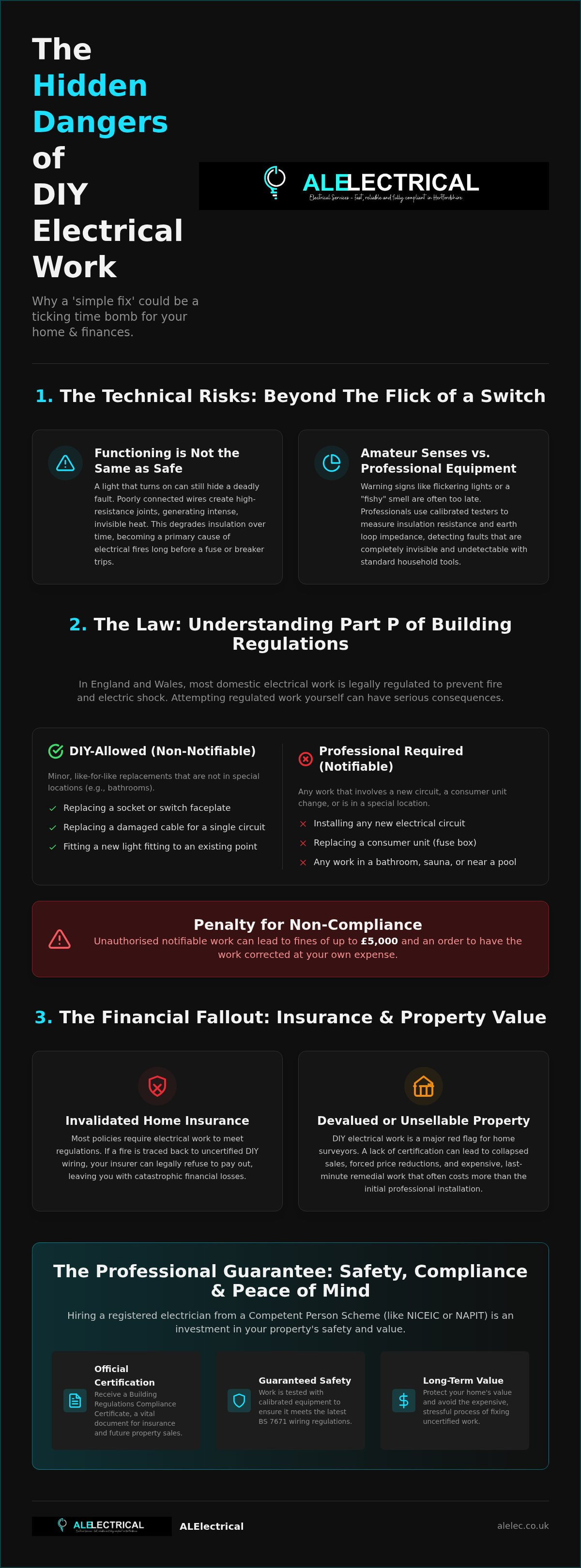
Many homeowners believe that if a new light switch works and the bulb illuminates, the job is a success. This logic is a dangerous trap. A circuit can function perfectly whilst hiding a high-resistance joint, where a loose or poorly terminated wire creates intense heat at a single point. Over time, this heat degrades cable insulation and can ignite a fire long before a fuse ever trips. This is one of the most significant dangers of diy electrical work uk; the hazards are often invisible until it's too late.
Maintaining an "alert electrical" mindset involves watching for subtle warning signs, such as flickering lights or a faint, fishy smell that suggests plastic is overheating. However, human senses are no match for professional equipment. We use calibrated multi-function testers to verify that a circuit is truly safe. Standard household tools simply cannot detect the faults that lead to shocks or fires, leaving your family at risk despite a seemingly successful installation.
Myth: I Can Learn Everything I Need from a YouTube Video
Digital tutorials are helpful for minor repairs, but they rarely address the depth of the UK electrical wiring regulations defined in BS 7671. Most videos skip the critical testing phase, such as earth loop impedance and insulation resistance checks. Fitting a part is not the same as designing a safe circuit. Professionals must calculate cable sizing based on the electrical load and environmental factors like thermal insulation. Without these calculations and the right testing gear, you can't be certain your system will actually disconnect during a fault, which is the vital difference between a safe home and a fatal accident.
Compliance and the Law: Understanding Part P and Your Legal Obligations
Understanding the legal framework is just as vital as the technical side of safety. In England and Wales, Part P of the Building Regulations dictates that most electrical work in dwellings must be designed and installed to protect people from fire or electric shock. Whilst you can legally perform "non-notifiable" tasks like replacing a light switch or socket cover, more complex jobs are strictly regulated to ensure your home remains safe.
Notifiable work includes:
Installing a completely new circuit.
Replacing a consumer unit, often referred to as a fuse box upgrade.
Any electrical work within "special locations" such as bathrooms or saunas.
Attempting these tasks yourself is one of the primary dangers of diy electrical work uk. If you bypass these rules, you could face local authority fines of up to £5,000. You may also be forced to pay for expensive remedial inspections to prove the work is safe, which often costs significantly more than hiring a professional in the first place.
Why "Notifiable Work" Requires a Registered Professional
Hiring an electrician registered with a Competent Person Scheme, such as NICEIC or NAPIT, simplifies your life. These professionals self-certify their work and handle the building control notification on your behalf. You'll receive a Building Regulations Compliance Certificate, which is a crucial document for your records. Without it, you'll likely struggle to sell your property, as savvy buyers and solicitors will demand proof that all electrical modifications meet current safety standards. If you're planning a project, it's always worth getting a professional quote to ensure your paperwork is as solid as your wiring.
The Financial Fallout: How DIY Mistakes Impact Insurance and Resale
Beyond the physical risks, the financial dangers of diy electrical work uk can be life-altering. Most UK home insurance policies include clauses requiring all electrical installations to meet national standards. If an investigator traces a fire back to an uncertified DIY modification, your insurer could legally reject your claim. This leaves you personally liable for the full cost of building repairs and content replacements, which can run into hundreds of thousands of pounds.
Property sales also reveal the true cost of cutting corners. The "Surveyor’s Nightmare" occurs when DIY wiring is flagged during a home survey, leading to stressful price re-negotiations or collapsed sales. Rectifying these issues retrospectively is often twice as expensive as hiring a professional from the start. Electricians must spend significant time tracing hidden faults and potentially removing wall finishes to fix errors that were never meant to be there.
Even common issues like a residual current device tripped shouldn't be handled with dangerous guesswork. Resetting a breaker repeatedly without identifying the root cause puts unnecessary stress on your home's infrastructure and could lead to a total system failure.
Securing Your Investment with Professional Certification
An Electrical Installation Condition Report (EICR) serves as a vital health check for your property. It provides a formal record of safety that adds tangible value to your home’s logbook. Whether you’re investing in a full house rewiring or simple maintenance, professional documentation ensures your family stays protected. This official paper trail offers a level of peace of mind that DIY work simply cannot match.
Protecting Your Home and Family for the Long Term
Choosing to step away from the tools and hire a professional isn't just about convenience; it's about making a commitment to your family's safety. Whilst saving money is important, the dangers of diy electrical work uk far outweigh the initial savings. A functioning light doesn't always mean a safe circuit. Professional testing is the only way to verify that your home is shielded from invisible fire hazards and legal complications under Part P of the Building Regulations.
At ALElectrical, we provide peace of mind through our expertise in modern consumer units and full house rewires. Our fully insured and accredited team offers transparent, fixed-fee pricing for safety inspections, ensuring your property remains both legal and insurable. Contact ALElectrical today for a free, no-obligation safety quote and keep your home compliant. We're here to help you maintain a secure and reliable home for the future.
Frequently Asked Questions
Is it illegal to do your own electrical work in the UK?
It isn't illegal to carry out your own electrical work, but you must ensure every modification complies with the latest wiring regulations (BS 7671). The law requires that any "notifiable" work is either performed by a registered competent person or inspected by Building Control. Failing to follow these rules is a criminal offence and can lead to significant fines.
Can I change a light fitting myself without an electrician?
You can generally replace existing light fittings, switches, or socket covers yourself as these are classed as non-notifiable minor works. However, you must still work safely by isolating the power and verifying that all connections are secure. If the project involves adding new circuits or working in a bathroom, the dangers of diy electrical work uk increase and professional help becomes a legal requirement.
What electrical work is notifiable under Part P?
Under Part P of the Building Regulations, notifiable work includes the installation of a new circuit, a full fuse box upgrade, or any alterations to circuits within "special locations" like bathrooms. These tasks must be legally reported to your local authority. Using a registered professional ensures you receive a compliance certificate, which is essential for proving the safety and legality of the installation.
Will my home insurance be void if I do my own wiring?
Many insurance providers include clauses that require electrical work to be completed by a qualified professional in accordance with national standards. If uncertified DIY wiring leads to a fire or accident, your insurer may refuse to pay out for the damages. Keeping professional records of your maintenance and upgrades is the best way to ensure your policy remains valid and your home is protected.


Comments