
EICR Remedial Electrical Work for Property Owners
An unsatisfactory EICR is a clear prompt for action, not a reason to panic. Remedial work after an unsatisfactory EICR means putting the reported electrical faults right or arranging further investigation where needed. Under BS 7671:2018+A4:2026, C1 and C2 observations make a report unsatisfactory; C3 and FI observations don’t affect its overall assessment.
It’s understandable to want clear answers about what needs doing, how urgent it is and which paperwork to keep. The EICR’s observation codes help distinguish immediate danger from issues needing remedial work or further investigation. Start by reading the observations and any stated deadlines.
This guide explains what remedial work can involve, how to arrange it and what certification to keep afterwards. You’ll also learn how the booking process can begin with the EICR findings, making it easier to understand the next practical step.
Table of Contents
What Is Remedial Electrical Work?
Remedial work addresses faults or risks recorded during an electrical inspection. The EICR identifies the findings; an electrician carries out repairs or further investigation and documents the outcome.
Arranging and documenting repairs
Use the EICR observations to describe the required work when arranging an appointment. Choose an electrician with the appropriate qualifications and compare quotes for the same scope of work. Before work starts, make sure the consumer unit, meter, sockets and switches are accessible.
According to UK Parliament, landlords in England must keep lettings electrically safe under the Electrical Safety Standards in the Private Rented Sector (England) Regulations 2020. Landlords must give tenants and the local housing authority the EICR and remedial confirmation within 28 days of completing work. On written request, they must provide these documents to the local housing authority within 7 days. Existing tenants must receive the EICR within 28 days of inspection, according to UK Parliament.
Certificates after repairs
Keep written confirmation of completed work with the original EICR. The certificate depends on the work: remedial work involving more than one circuit is generally documented with an Electrical Installation Certificate. Work on a single circuit may use a Minor Electrical Installation Works Certificate. If new circuits are installed, an Electrical Installation Certificate should be issued. Keep these records for future reference.
Examples of remedial work
Repairs may include replacing a faulty socket, correcting a lighting-circuit fault or improving protective bonding. A consumer-unit upgrade may be needed where the report identifies an issue that requires it. The electrician should explain how each repair addresses the relevant observation and provide the appropriate certification. Work should follow BS 7671, the IET Wiring Regulations, and the completed records should correspond to the work carried out.
EICR fault codes and what an unsatisfactory report means
Fault codes indicate whether an installation presents danger, needs repairs or requires further investigation. Rules differ across the UK: the regulations discussed here apply in England, while Scotland, Wales and Northern Ireland have separate requirements.
Understanding EICR classification codes
Under BS 7671:2018+A4:2026, C1 and C2 observations make an EICR unsatisfactory. C1 means danger is present; C2 identifies a potentially dangerous fault. FI means further investigation is required, while C3 recommends an improvement. C3 observations recommend improvement, while FI findings call for further investigation; their effect on the report’s overall assessment depends on the applicable requirements.
Repairs required by EICR codes
A C1 fault needs immediate action. The affected circuit or equipment should be isolated until permanently repaired, with urgent attention to danger. A C2 fault also requires remedial works because it’s potentially dangerous. For FI, arrange the investigation to establish the fault and required work. C3 observations identify improvements, but don’t require repairs for a satisfactory EICR. Use the report’s findings to identify what must be carried out.
Remedial work deadlines
In England, landlords must complete required remedial work or further investigation within 28 days, or sooner if the report sets an earlier deadline, according to UK Parliament. For an FI finding, landlords must commission further investigation within 28 days, according to UK Parliament. The deadline runs from the inspection date, so arrange the work promptly. If a landlord doesn’t comply with a Remedial Notice, the local authority can arrange the work and recover its costs. If you need help addressing electrical findings, discussing the reported faults can help clarify the next step.
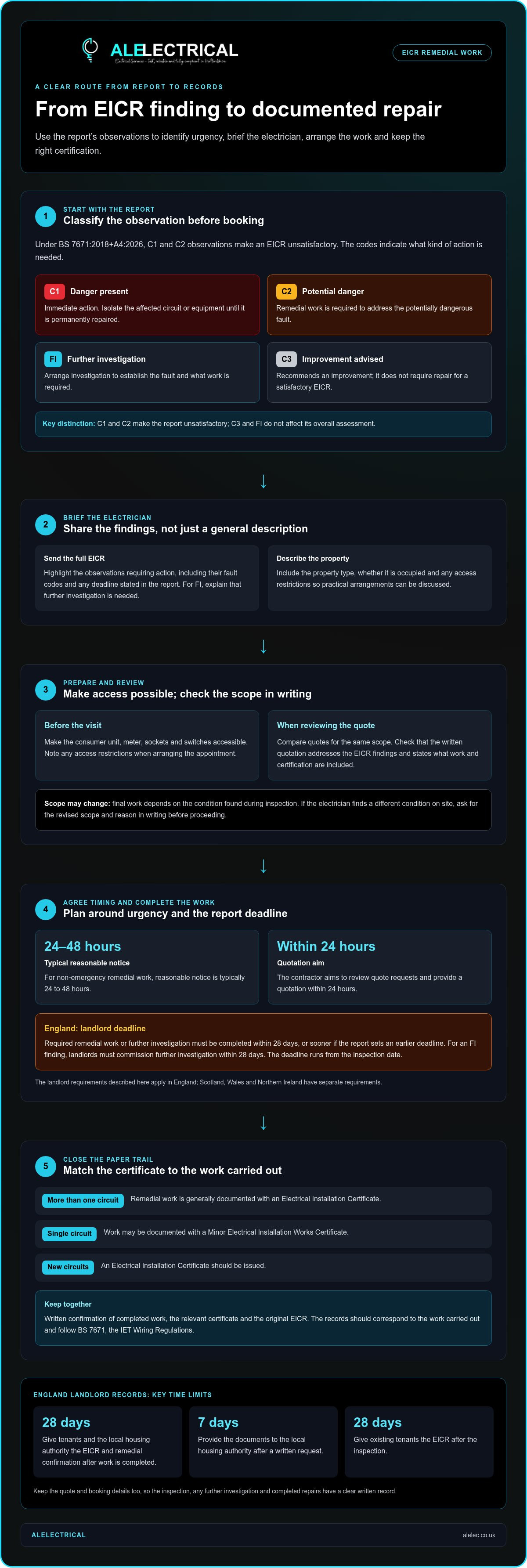
EICR remedial work booking process
To arrange remedial work after an unsatisfactory EICR, start with the report rather than a general description of the property. Send the electrician the findings, fault codes and any stated deadline. This helps clarify the repairs or further investigation needed before arranging access. Include the property type and whether it’s occupied, so practical arrangements can be discussed.
Share the documents. Provide the full EICR and highlight observations requiring action. For an FI finding, explain that further investigation is required.
Describe access and condition. Note any access restrictions and clear the consumer unit, meter, sockets and switches before the visit.
Review the quotation. Check that the written scope addresses the report’s findings and states what work and certification are included. The final work depends on the condition found during inspection.
Agree access and timing. Reasonable notice for non-emergency remedial work is typically 24 to 48 hours. For quote requests, the contractor aims to review them and provide a quotation within 24 hours.
Landlords arranging remedial work after an unsatisfactory EICR should plan around the report’s deadline and retain the quote and booking details. If the electrician identifies a different condition on site, ask for the revised scope and the reason in writing before proceeding. This creates a clear record linking the inspection, repairs and any further investigation.
After work is completed, keep the written confirmation and relevant certificate with the original EICR. These documents show what action was taken and help landlords provide evidence when required. To discuss electrical findings and arrange the next step, get in touch about your remedial work.
ALElectrical: House Rewires
ALElectrical carries out full rewires for property owners whose installations need more extensive renewal than individual repairs. An unsatisfactory EICR can identify faults across an installation; the observations help clarify whether specific repairs or broader work are appropriate. A full rewire may be relevant when findings point to widespread issues, while a fuse box upgrade addresses a different part of the installation. The right option depends on the reported condition and required work.
ALElectrical also provides EICR and Solar & Battery services. If your report raises concerns about the installation or you’re planning wider electrical work, its services offer a practical next step to discuss. Contact ALElectrical to talk about your property’s electrical requirements.
Take the next step with a clear plan
For remedial work after an unsatisfactory EICR, use the report to shape a practical plan for your property. Separate urgent safety actions from longer-term improvements, then consider how any wider electrical project fits your plans for the building. A targeted repair may be sufficient; broader work may be appropriate if the findings point to more extensive issues.
ALElectrical offers House Rewires, Fuse Box Upgrades and Solar & Battery services for different property requirements. The most suitable next step depends on what the inspection found and the work you want to address. Keeping the report and your questions together can make the conversation clearer and help you decide how to proceed.
Contact ALElectrical to discuss remedial work and take a considered step towards a safer, well-maintained electrical installation.
Frequently Asked Questions
What are EICR remedial works?
EICR remedial work addresses safety faults or unresolved findings recorded during an electrical inspection. The scope depends on the report: it may involve correcting a fault, replacing an affected component or investigating an observation before deciding on repairs. For a clear record, match each completed item to the relevant observation and retain the electrician’s written confirmation.
Can I keep using my premises with an unsatisfactory EICR?
An unsatisfactory result doesn’t automatically mean every part of the premises is unsafe, but it also doesn’t confirm that unaffected areas are safe. Follow any isolation instructions in the report. In particular, C1 faults indicate danger: keep affected circuits or equipment isolated until permanently repaired. Don’t reconnect isolated equipment simply because other parts of the installation remain in use.
Landlords in England: what is the 28-day rule?
In England, landlords must complete required remedial work or further investigation within 28 days, or sooner if the report gives an earlier deadline, according to UK Parliament. The period runs from the inspection date, rather than when the landlord receives the report. For an FI observation, commission the further investigation within 28 days and record when it’s arranged.
Should I address all EICR defects or focus on the minimum requirements?
Prioritise findings that affect safety or the report’s assessment, and consider the remaining recommendations as part of planned maintenance. C1 and C2 findings require action, while a C3 observation recommends an improvement but doesn’t require work for a satisfactory result. If you’re planning repairs in stages, keep the outstanding observations visible and avoid treating recommendations as completed work.
What does “unsatisfactory” actually mean?
“Unsatisfactory” is the EICR’s overall assessment of the installation, not a statement that every circuit has failed. Under BS 7671:2018+A4:2026, one or more C1 or C2 observations make the report unsatisfactory. Read the individual observations to understand where the issue lies, how it’s classified and whether the report requires immediate action or further investigation.



Comments