
AFDD Consumer Unit Regulations and Whether Your Home Needs One
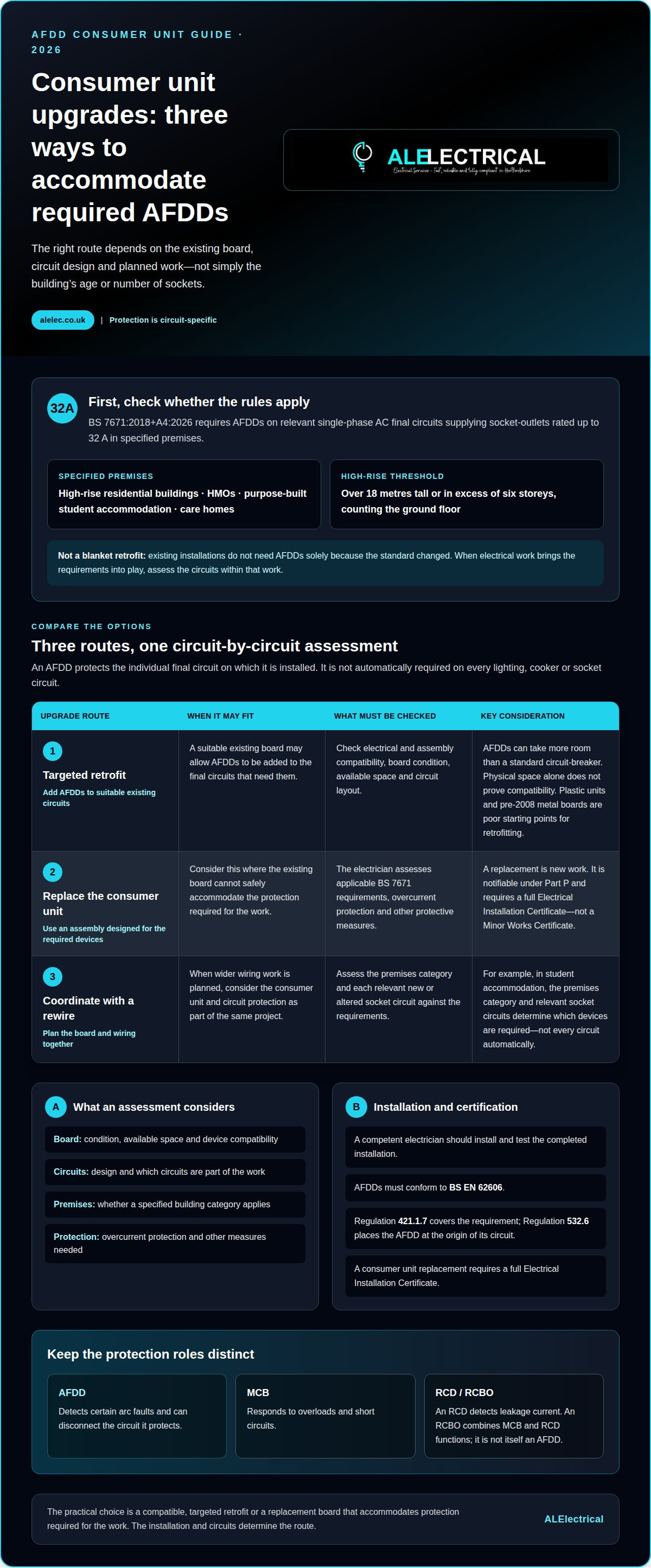
A consumer unit upgrade doesn’t mean every circuit in every home needs an AFDD. Under BS 7671:2018+A4:2026, AFDDs are required on single-phase AC final circuits supplying socket-outlets rated up to 32 A in high-rise residential buildings, HMOs, purpose-built student accommodation and care homes. The AFDD consumer unit regulations 2026 don’t require existing installations to be retrofitted.
It’s understandable to wonder whether an older board needs replacing or whether protection belongs on every socket circuit. AFDDs detect certain electrical arc faults and can disconnect the affected circuit. Understanding the AFDD consumer unit regulations 2026 also means knowing how planned electrical work affects the circuits being assessed. This guide explains which homes and circuits the rules cover, when they apply, and how a consumer unit upgrade can accommodate the required protection.
Table of Contents
What Is an AFDD and Does My Consumer Unit Need One?
In 2026, BS 7671:2018+A4:2026 requires AFDDs on single-phase AC final circuits supplying socket-outlets rated up to 32 A in specified premises. These wiring requirements apply across the UK, rather than setting separate AFDD circuit thresholds for England, Scotland, Wales and Northern Ireland.
AFDD requirements for installations and new work
An AFDD detects certain arc faults and disconnects the circuit it protects. Regulation 421.1.7 covers the requirement, while Regulation 532.6 places the AFDD at the origin of its circuit. The rules apply to relevant circuits in new work, including a consumer unit replacement, rewire or new socket circuit.
Existing installations don’t have to be retrofitted with AFDDs solely because the standard has changed. However, when electrical work brings BS 7671 requirements into play, the circuits within that work need assessment. Since 15 April 2026, Amendment 4 has applied, using “high-rise residential buildings” for the relevant building category.
Required premises include high-rise residential buildings, HMOs, purpose-built student accommodation and care homes. A high-rise residential building is over 18 metres tall or in excess of six storeys, with the ground floor counted. For other relevant locations, AFDDs may merit consideration on a risk-assessed basis. EV charging circuits conforming to BS EN 61851 are exempt from the requirement described here.
AFDD installation and certification
A competent electrician should install an AFDD consumer unit and test the completed installation. AFDDs must conform to BS EN 62606, and a consumer unit replacement is notifiable under Part P.
The replacement requires a full Electrical Installation Certificate, not a Minor Works Certificate. This records the completed electrical work and its testing. For a new socket circuit, the electrician assesses the circuit and premises against Regulation 421.1.7; the AFDD requirement does not mean every circuit in a home needs one.
Do I need an AFDD on every circuit?
No. AFDD protection applies to relevant socket circuits in specified premises, not automatically to every circuit in every home. In other locations, a risk assessment can help determine whether AFDDs are appropriate.
AFDD use across circuits and premises
An AFDD protects the individual final circuit on which it is installed, whether that circuit is a ring or supplies individual sockets. The requirement is circuit-specific, not a blanket instruction to fit an AFDD to every lighting, cooker or socket circuit.
BS 7671’s 2024 amendment extended the recommendation to use AFDDs beyond premises where they’re mandatory. Student accommodation and other locations can therefore merit risk-based consideration, even when the rules don’t require protection on every circuit.
Mandatory AFDDs and exceptions
Specified high-rise residential buildings, HMOs, purpose-built student accommodation and care homes have mandatory protection for relevant socket circuits. The exceptions described in BS 7671 include EV charging circuits conforming to BS EN 61851 and medical locations in groups 0 to 2.
For other premises, a risk assessment can help determine whether additional arc-fault detection is appropriate. The AFDD must suit the installation and circuit. Incorrect selection or installation can leave protection ineffective or incompatible with the consumer unit.
An AFDD detects arc faults. An MCB responds to overloads and short circuits, while an RCD detects leakage current. An RCBO combines MCB and RCD functions, but is not itself an AFDD. Each device addresses a different electrical risk.
For AFDDs without automatic testing, BEAMA advises testing every six months. If a device trips repeatedly, don’t bypass it or keep resetting it; have the circuit assessed to identify the cause. A planned charger can also be considered alongside the relevant circuit requirements through EV charger installation.
Consumer unit upgrade options
A consumer unit upgrade can provide space for AFDDs on the final circuits that need them. The right arrangement depends on the existing board, circuit design and planned work, not simply the building’s age or the number of sockets.
One option is adding AFDDs to suitable existing circuits. However, physical space alone doesn’t prove electrical or assembly compatibility. AFDDs can take more room than a standard circuit-breaker, so a crowded board may not accommodate them safely. Plastic consumer units and pre-2008 metal boards are poor starting points for retrofitting.
A second option is replacing the consumer unit with an assembly designed for the required protective devices. A replacement is new work, so the electrician assesses applicable BS 7671 requirements, including the relevant Amendment and edition. The assessment also considers overcurrent protection and any other protective measures the installation needs.
If a rewire is planned, the consumer unit and wiring can be considered as part of the same project. This helps coordinate AFDD protection with the design of new circuits. For example, in student accommodation, the premises category and relevant socket circuits determine which devices are required. Fitting AFDDs to every circuit is not automatically necessary.
The practical options are a compatible, targeted retrofit or a consumer unit replacement that accommodates the protection required for the work. A qualified electrician assesses the board’s condition, available space, circuit layout and device compatibility before specifying AFDDs.
For a board assessment and suitable upgrade, arrange a fuse box upgrade.
ALElectrical
ALElectrical can help you understand how AFDD requirements apply to your existing installation or planned electrical work. An EICR assesses the condition of an existing installation, while a fuse-box upgrade may be appropriate if the consumer unit needs replacing or adapting. If wider wiring work is planned, a house rewire offers an opportunity to consider circuit protection as part of the project. The right option depends on the installation, the circuits involved and the work required. ALElectrical also provides Solar & Battery services, which can be considered alongside wider electrical plans. To discuss your consumer unit and planned work, contact ALElectrical for a free, no-obligation quote.
Plan your next electrical project with confidence
Use the afdd consumer unit regulations for 2026 as a prompt to make electrical safety part of your home’s wider plans, rather than treating the consumer unit as an isolated decision. If a renovation or wiring project is approaching, considering the board and circuit protection together can help shape a more joined-up plan. ALElectrical also undertakes house rewires, Solar & Battery work and fuse box upgrades, so your next step can reflect the needs of the whole property.
For practical advice on your installation and planned work, contact ALElectrical about your consumer unit. A clear discussion can help you move forward with a plan that suits your home.
Frequently Asked Questions
AFDDs: Does Your Home Need an Arc Fault Detection Device?
Not every home needs AFDDs on every circuit. Requirements depend on the premises and the socket circuit involved; in other locations, a risk assessment can help determine whether protection is appropriate. A change in the rules does not, by itself, mean an existing installation needs a retrofit. If you’re planning electrical work, assess the circuits affected by that work.
When does the 18th edition require AFDDs?
Under the current 18th Edition requirements, AFDDs are required for relevant socket circuits in specified high-rise residential buildings, HMOs, purpose-built student accommodation and care homes. The requirement applies to single-phase AC final circuits supplying socket-outlets rated up to 32 A. It becomes relevant when applicable electrical work is undertaken, rather than creating a general retrofit duty for existing installations.
What is the BS number for an AFDD RCBO?
BS EN 62606 is the conformity standard identified for AFDDs. An AFDD RCBO combines arc-fault detection with the protective functions of an RCBO, but the term doesn’t establish a separate standard number for the combined device. The electrician must select equipment suitable for the consumer unit and circuit, and ensure the AFDD function conforms to the relevant standard.
Which edition of BS 7671 should this guide use?
This guide uses BS 7671:2018+A4:2026, the current edition identified for the 2026 AFDD requirements. The amendment came into force on 15 April 2026. For work on an installation, the applicable requirements depend on the work being carried out and the standard in force for that work. The edition is a wiring standard, not an Act of Parliament.
Are AFDDs different from RCBOs?
Yes. An AFDD detects certain arc faults, while an RCBO combines protection against overcurrent and residual current. Their functions address different electrical faults, so an RCBO does not automatically provide AFDD protection. A combined AFDD RCBO includes arc-fault detection alongside RCBO functions; the selected device and circuit arrangement must suit the installation.

Comments