_.jpg)
Emergency Lighting Certificate: The 2026 UK Compliance Guide
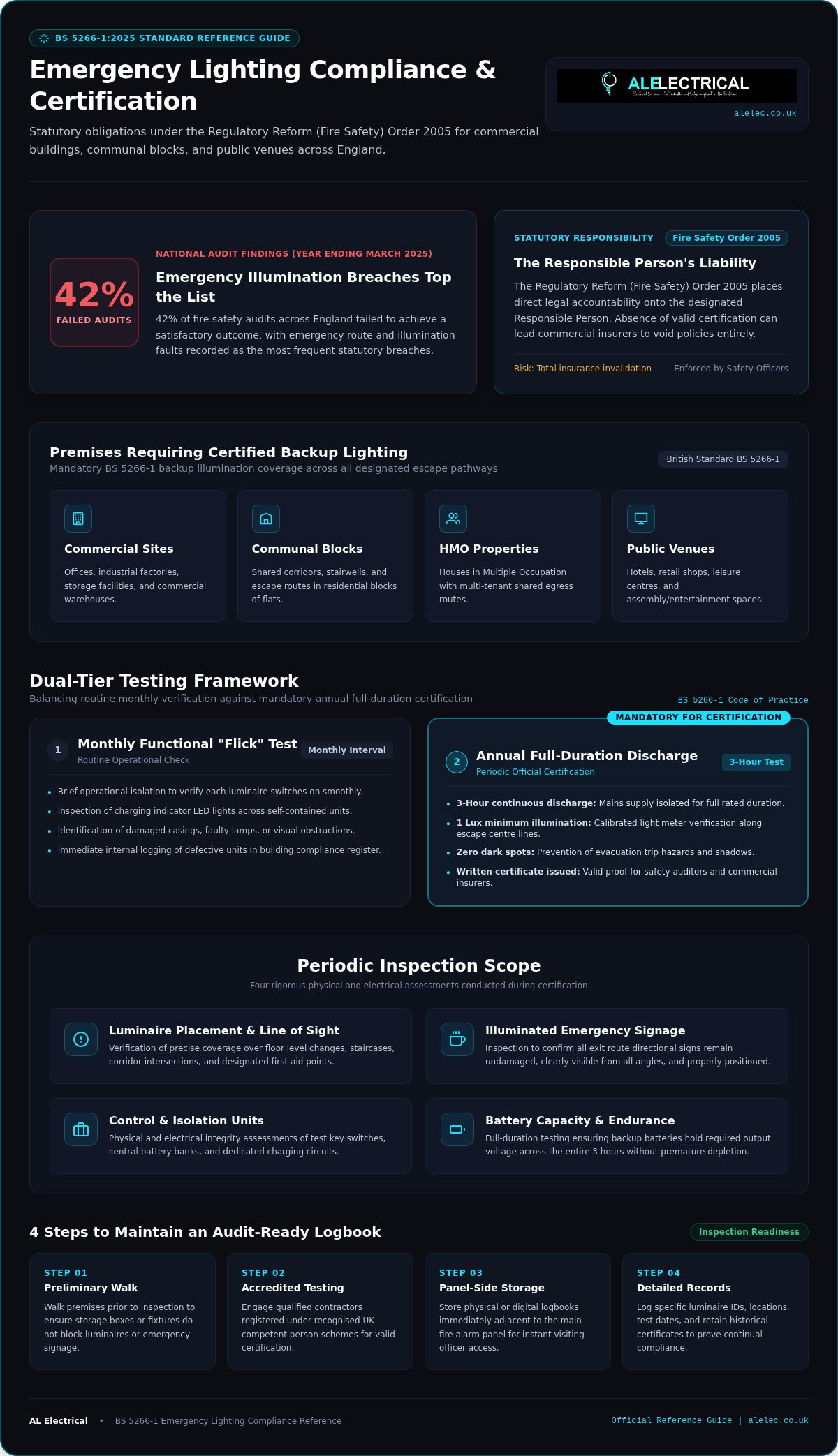
In the year ending March 2025, 42% of fire safety audits across England failed to achieve a satisfactory outcome, with emergency route and illumination faults topping the list of recorded breaches. If you oversee commercial premises, you already know how daunting it can feel to balance routine maintenance against statutory paperwork. While monthly flick tests keep your system operational day to day, only an official emergency lighting certificate guarantees that your building meets mandatory British Standards and keeps your insurance fully intact.
You deserve absolute clarity on your legal duties under the Regulatory Reform (Fire Safety) Order 2005. In this guide, we break down the updated BS 5266-1:2025 requirements, explain how to prepare for your annual three-hour discharge inspection, and show you how to maintain an audit-ready logbook with total confidence.
Table of Contents
What Is an Emergency Lighting Certificate Under BS 5266-1?
An emergency lighting certificate is a formal document verifying that your property's backup illumination complies with British Standard BS 5266-1. While regular operational checks confirm that individual units switch on, this periodic certificate proves that the entire design operates safely under mains failure conditions. Every dedicated emergency light fitting, whether self-contained or fed by central batteries, must supply sufficient illumination along designated escape pathways to ensure safe evacuation.
Premises that require certified backup lighting include:
Commercial buildings such as offices, factories, and warehouses
Communal spaces in residential blocks of flats
Houses in Multiple Occupation (HMOs)
Public venues including hotels, shops, and entertainment facilities
Without an up-to-date certificate, safety authorities can deem your site non-compliant. This oversight leaves occupants vulnerable and exposes building owners to immediate legal consequences.
Legal Obligations Under the Regulatory Reform (Fire Safety) Order 2005
The Regulatory Reform (Fire Safety) Order 2005 places direct legal accountability onto the designated Responsible Person for a building. Fire safety officers frequently demand this verification during routine audits. If an incident occurs and you cannot present a valid emergency lighting certificate, commercial insurers may void your policy entirely, refusing coverage for damages or third-party liabilities.
Meeting your statutory obligations doesn't have to disrupt your daily business operations. You can integrate periodic verification alongside comprehensive electrical maintenance services to protect your building, satisfy safety inspectors, and keep your essential compliance documentation up to date.
What Qualified Engineers Inspect During Periodic Certification
When an engineer arrives to inspect your premises, they conduct far more than a brief glance at charging indicator lights. Securing a compliant emergency lighting certificate requires a rigorous physical and electrical assessment aligned with the BS 5266-1 Code of Practice. Your engineer systematically assesses system readiness across several key areas:
Luminaire placement and line of sight: Ensuring fittings illuminate changes in floor level, corridor intersections, and first aid points.
Illuminated signage: Verifying exit route signs remain clearly visible, undamaged, and correctly positioned.
Control and isolation units: Checking key switches, central battery banks, and charging circuits for physical integrity.
Battery capacity: Ensuring internal batteries hold sufficient power without premature depletion.
Navigating the Mandatory 3-Hour Annual Discharge Test
The core element of issuing an emergency lighting certificate is the full three-hour continuous discharge test. By isolating normal mains supplies, the engineer forces backup cells to sustain operation across their full rated life. Using calibrated luminance meters, they verify escape routes achieve the mandatory 1 lux minimum illumination along centre lines, preventing dark spots that cause trip hazards during evacuations.
If you suspect your building's footprint or layout has changed since fittings were installed, review your setup against modern layout standards detailed in our emergency lighting installation guide. For complete peace of mind across your facilities, partnering with qualified specialists at alelec.co.uk ensures every luminaire performs reliably when needed most.
How to Secure Your Certificate and Maintain an Audit-Ready Logbook
Securing an official emergency lighting certificate starts with choosing an accredited electrical contractor registered under recognised UK competent person schemes. Before booking your inspection, walk your premises to conduct a quick preliminary review. Ensure storage boxes haven't blocked luminaires and confirm emergency signage remains clearly visible. Once your contractor finishes testing, obtain your written certificate and file it straight into your on-site compliance binder.
A complete compliance record relies on consistent upkeep:
Keep physical or digital logbooks accessible near the main fire alarm panel.
Record the specific luminaire ID, location, and test date for every unit checked.
Retain historical certificates to demonstrate ongoing maintenance to safety inspectors.
Rectifying Non-Compliance and Recording Monthly Functional Tests
If an engineer identifies defects during an inspection, prompt repairs are critical. Issues such as degraded battery cells or failed LED drivers must be resolved quickly to avoid invalidating your coverage. Pair routine in-house checks with your periodic certification by logging monthly functional flick tests alongside your formal paperwork. Recording every routine test and remedial repair creates an unbroken audit trail that visiting fire officers can inspect at a glance.
Protecting your occupants shouldn't create operational stress. Arrange your inspection with ALElectrical for complete certified compliance across all commercial premises, giving you lasting peace of mind that your life-safety systems meet statutory standards.
Keep Your Building Safe, Certified, and Fully Compliant
Staying on top of life-safety duties protects your occupants and shields your business from disruptive enforcement notices. Fulfilling your statutory obligations under the Fire Safety Order requires more than intermittent checks; it takes structured testing, transparent records, and an up-to-date emergency lighting certificate. By pairing monthly in-house tests with an annual three-hour discharge assessment, you ensure backup illumination works reliably when it matters most.
Working with fully accredited UK electrical contractors gives you access to rigorous compliance reports aligned with BS 5266-1, along with clear remedial guidance for failed emergency luminaires. You don't have to face safety audits with uncertainty. Book your professional emergency lighting inspection with ALElectrical today to protect your premises and secure lasting peace of mind.
Frequently Asked Questions
Is an emergency lighting certificate a legal requirement in the UK?
Yes, maintaining documentary proof of compliant backup lighting is a statutory duty under the Regulatory Reform (Fire Safety) Order 2005. The law mandates that the designated Responsible Person must keep life-safety systems fully operational. An emergency lighting certificate provides the official evidence required by fire authorities and insurers to prove your building complies with BS 5266-1 standards.
How often does an emergency lighting certificate need to be renewed?
An emergency lighting certificate must be renewed annually following a full-duration inspection. British Standard BS 5266-1 requires a competent engineer to conduct a continuous discharge test, usually lasting three hours, every 12 months. This periodic review verifies that internal backup batteries still sustain adequate power, allowing your engineer to reissue certified compliance for your premises.
What is the difference between a monthly flick test and annual certification?
A monthly flick test is a brief operational check, whilst annual certification evaluates sustained performance. In-house staff can carry out the monthly test by isolating mains power momentarily to ensure luminaires switch on. Annual certification requires a qualified engineer to simulate an extended power outage for up to three hours, checking battery endurance, luminance levels, and physical wiring.
What happens if a building fails its annual emergency lighting test?
If your system fails, your inspecting engineer issues a report detailing identified defects, such as exhausted batteries or unlit exit signs. You must carry out prompt remedial repairs to resolve these issues. Once faults are rectified by a competent electrical contractor, the system is re-tested to confirm full operational capacity, allowing your contractor to issue a satisfactory certificate.


Comments