_.jpg)
Planning a Professional Electrical Installation: The 2026 Homeowner and Business Guide
If you added an EV charger and a solar battery to your property tomorrow, would your current fuse box keep the lights on or trigger a safety shutdown? Most homeowners and business owners feel a sense of unease when planning a major electrical installation, especially when faced with technical jargon like BS 7671 or Part P compliance. It's perfectly natural to worry whether your property can handle the high power demands of modern green technology. We understand that you want a system that's safe, reliable, and ready for the future.
This guide simplifies the entire process to help you manage your project with confidence. You'll discover how to ensure every wire and circuit meets the latest safety standards for 2026. We'll explore how to verify compliance, avoid common regulatory pitfalls, and future-proof your property for a sustainable, high-tech world with total peace of mind.
Table of Contents
Understanding Modern Electrical Installation Standards and Safety
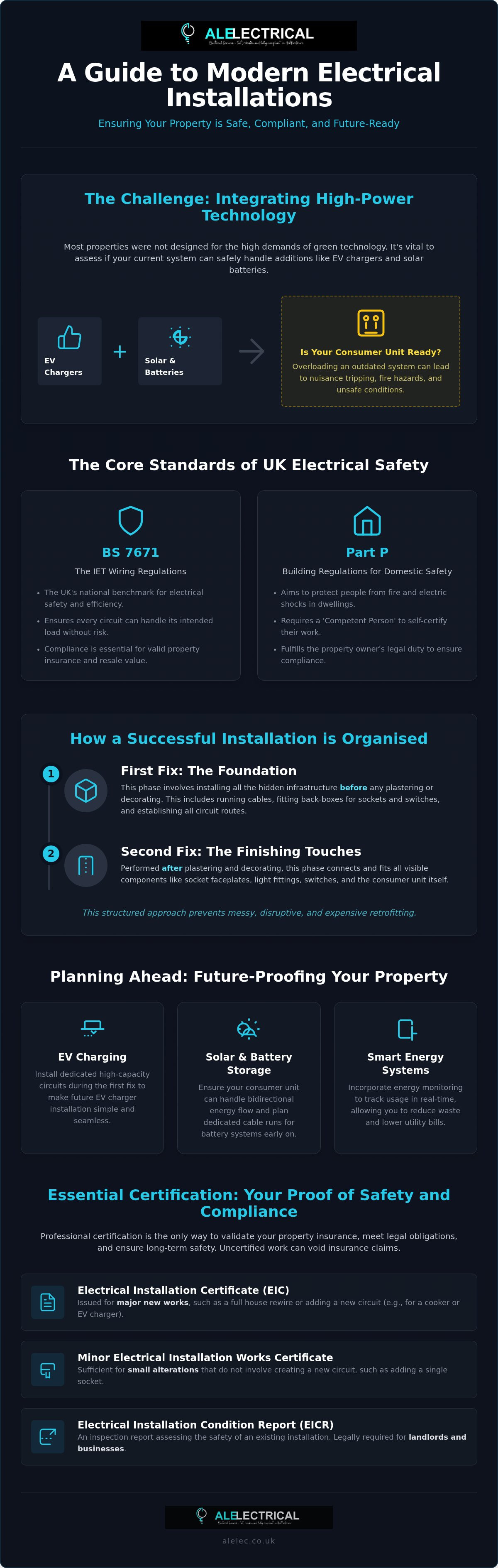
An electrical installation isn't just about the appliances you plug in; it refers to the fixed components that make up your property's power network. This includes the consumer unit, cabling, sockets, and switches that form the permanent infrastructure of a building. To keep these systems safe, they must adhere to recognised electrical installation standards. In the UK, this means following BS 7671, also known as the IET Wiring Regulations. These rules are the national benchmark for safety and efficiency, ensuring every circuit can handle its intended load without risk.
Choosing a professional for your project is vital for several reasons beyond basic safety. Valid documentation is essential for insurance cover; many providers won't pay out for claims if the work isn't certified by a qualified expert. Additionally, having a compliant system significantly boosts property resale value. Prospective buyers always look for proof that the electrics are modern and safe. We're also seeing a rise in smart installations that incorporate energy monitoring and automated controls, allowing you to track your usage in real-time whilst reducing waste.
The Role of Part P and the Competent Person Scheme
Part P of the Building Regulations focuses on domestic safety. It ensures electrical work protects people from fire or electric shocks. Hiring an electrician registered with a competent person scheme allows them to self-certify their work. This removes the need for you to contact building control and provides you with essential compliance certificates. It's your legal obligation as a property owner to ensure all electrical work meets current building standards.
How to Organise a Successful Electrical Installation Project
A successful electrical installation requires a methodical approach, especially during renovations or new builds. Dividing the work into a "first fix" and "second fix" ensures that structural elements like cabling and back-boxes are hidden before plastering begins. It's essential to have clear communication with your installer regarding socket placement, lighting circuits, and even data cabling for home offices. Planning these details early prevents the need for messy retrofitting later. If you're considering a total system overhaul, our house rewiring guide provides a deep dive into the safety process and future-proofing.
Before adding high-draw appliances, you must assess the current load capacity amongst your existing circuits. Overloading a system can lead to nuisance tripping or fire hazards. While UK residential work follows BS 7671, commercial projects often align with international safety benchmarks, such as OSHA electrical safety standards, to ensure peak workplace protection. If you're unsure about your property's capacity, our team can provide a free, no-obligation quote to help you plan effectively.
Future-Proofing for Solar PV and EV Charging
Modern energy demands require a consumer unit capable of handling bidirectional flow, particularly if you're exporting solar energy. When planning your installation, consider the infrastructure for dedicated EV charging circuits now to avoid tearing up floors later. You should also plan dedicated cable runs for home solar battery storage during the initial phase. This foresight ensures your home is ready for the green energy transition without extra disruption. It's much simpler to lay the groundwork today than to retrofit a complex system in two years.
Navigating Compliance: Certificates and Long-Term Maintenance
Completing an electrical installation is only half the journey; the final step is securing your compliance paperwork. For any significant work, such as a full rewire or a new circuit, you must receive an Electrical Installation Certificate (EIC). This document confirms the design, construction, and testing meet national safety standards. For smaller tasks like adding a single socket, a Minor Works Certificate is usually sufficient. Whilst uncertified labour might seem cheaper initially, professional certification is the only way to validate your property insurance and meet legal obligations. Following OSHA electrical safety standards and UK regulations ensures that your investment remains protected against future liability.
Ongoing safety requires a commitment to regular electrical maintenance services. Dust, wear, and loose connections can degrade a system over time, even if it was installed perfectly. Routine checks catch these minor issues before they become expensive repairs or fire hazards. It's a small investment that provides immense peace of mind for both families and staff members.
The Importance of the EICR for Landlords and Businesses
An Electrical Installation Condition Report (EICR) acts as a comprehensive health check for your existing wiring. For rental properties and most commercial buildings, these inspections are legally required every five years, or sooner if specified by an engineer. If your report returns an "Unsatisfactory" result, it identifies specific faults that require urgent attention. Codes like C1 or C2 indicate immediate or potential danger. These must be rectified within 28 days to maintain your legal standing. We help clients navigate these repairs quickly to ensure their properties remain safe and fully compliant.
Secure a Safer Future for Your Property
Planning a successful electrical installation doesn't have to be an overwhelming task. By focusing on compliant BS 7671 standards and organising your project in clear stages, you protect both your property's value and your family's safety. Whether you're upgrading an old fuse box or integrating modern energy-saving technology like solar batteries and EV chargers, early preparation is the key to a seamless transition. It's about building a system that handles today's needs whilst staying ready for tomorrow's innovations.
Our team is here to help you navigate these technical complexities with total transparency and reliability. We specialise in future-proofed systems and provide fixed-fee quotes so you can plan your budget with complete confidence. Contact ALElectrical today for a professional, no-obligation quote on your next electrical installation project. We look forward to helping you create a more efficient and secure environment for your home or business.
Frequently Asked Questions
What is the difference between a first fix and a second fix in an electrical installation?
First fix is the initial phase where cables and back-boxes are installed before walls are plastered or floors are laid. Second fix occurs after decorating, when the sockets, switches, and consumer unit are connected to the live system. This two-stage process is standard for any large-scale electrical installation to keep wiring hidden and protected whilst ensuring a tidy final finish.
Do I need a new fuse box for a modern electrical installation?
You'll likely need a fuse box upgrade if your current board lacks RCD protection or cannot accommodate high-draw technology like EV chargers. A modern consumer unit is essential for a compliant electrical installation, offering better safety against surges and faults. We recommend a professional inspection to see if your existing system can safely handle 2026 energy demands.
How long does a typical residential electrical installation take to complete?
A full residential rewire generally takes between five and ten working days depending on the property's size and complexity. Smaller projects, such as adding a new circuit or upgrading a consumer unit, are often completed within a single day. We provide fixed-fee quotes that outline the expected duration so you can manage your daily routine with minimal disruption.
Is it legal to carry out my own electrical installation work in the UK?
Most significant electrical work in the UK is legally required to meet Part P of the Building Regulations. Whilst you can perform very minor repairs, notifiable work like new circuits or bathroom electrics must be certified by a qualified professional. Attempting DIY on major projects can invalidate your insurance and lead to safety hazards that put your property at risk.


Comments