
18th edition wiring regulations: why they matter and when they apply
The 18th Edition is more than a technical handbook: it is the current UK benchmark for electrical installation work. The current version is BS 7671:2018+A4:2026, and Amendment 4 was published on 15 April 2026. For homeowners, having the 18th edition wiring regulations explained clearly makes it easier to understand why the standard matters and when the latest amendment applies.
It’s understandable to wonder whether BS 7671 is itself a legal requirement or a standard electricians follow as good practice. It isn’t an Act of Parliament, but it is recognised as the industry’s accepted standard of good practice. This article explains that distinction, outlines how the regulations support safer electrical installations and clarifies the Amendment 4 transition. You’ll come away with a practical picture of what the current edition means, without needing to work through dense technical wording on your own.
Table of Contents
When was Amendment 4 to BS 7671:2018 published?
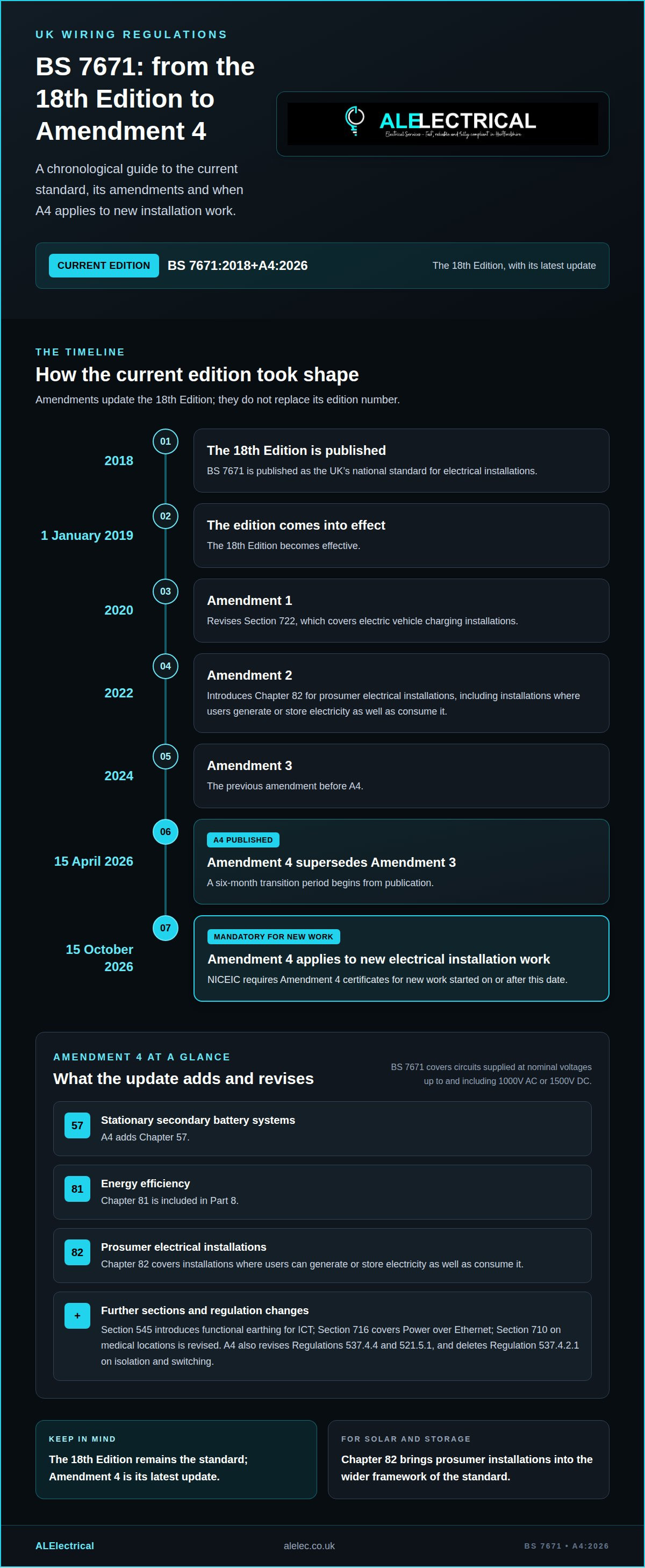
Amendment 4 to BS 7671:2018 was published on 15 April 2026. It supersedes Amendment 3 (2024), with a six-month transition period from publication. From 15 October 2026, Amendment 4 is the mandatory version for new electrical installation work.
The IET and British Standards Institution (BSI) co-publish BS 7671, the UK’s national standard for electrical installations. Often called the 18th Edition, it is a standard, not an Act of Parliament. It sets technical requirements for installations rather than serving as legislation itself.
The 18th Edition was published in 2018 and came into effect on 1st January 2019. Amendment 1 followed in 2020, Amendment 2 in 2022 and Amendment 3 in 2024. Amendment 1 revised Section 722 for electric vehicle charging, while Amendment 2 introduced Chapter 82 for prosumer electrical installations.
The 18th Edition regulations apply to EV chargers through requirements in Section 722. For solar PV systems operating in parallel with the network, Amendment 2’s Chapter 82 addresses prosumer installations. The UK Government, legislation.gov.uk states that installers must advise the distributor before or at commissioning when an energy source operates in parallel with a network.
BS 7671 covers electrical circuits supplied at nominal voltages up to and including 1000V AC or 1500V DC. Amendment 4 adds Chapter 57 for stationary secondary battery systems and Chapter 81 on energy efficiency. It also introduces Section 545 for functional earthing for ICT and Section 716 for Power over Ethernet, and revises Section 710 on medical locations.
Is BS 7671 a Legal Requirement?
BS 7671 is not an Act of Parliament, but it is the accepted standard of good practice in the electrical industry and courts. The Health and Safety at Work Act includes section 17, a legal reference concerning non-compliance with the standard. Compliance with BS 7671 and associated requirements also supports compliance with the Electricity at Work Regulations 1989.
This distinction matters: BS 7671 sets technical expectations for electrical installations, while legislation establishes legal duties. Building Regulations are a separate consideration for certain building work. Whether they apply depends on the nature and location of the work. An update to BS 7671 can affect how an installation is designed or assessed, but it doesn’t replace relevant legal requirements.
Inspection and testing help establish whether circuits and protective devices are suitable and working as intended. An Electrical Installation Condition Report (EICR) records the condition of an existing installation and issues identified during assessment. It helps landlords, businesses and homeowners understand whether repairs or further work may be needed. Inspection intervals depend on the property’s use and the installation’s condition.
BS 7671 also addresses protection against electric shock and fire. For example, RCD protection is required for socket-outlet circuits rated up to 32A in domestic and commercial premises. Safe work also involves controlling electrical isolation. A permit-to-work process can help communicate what equipment is isolated and who is authorised to work on it; it does not replace testing or safe working practices.
For an existing installation, electrical maintenance can help address issues identified through inspection and testing.
Current edition of the UK wiring regulations
The current UK edition is BS 7671:2018+A4:2026. Amendment 4 is now the applicable version for new electrical installation work, following its six-month transition period. The key takeaway is to distinguish the edition number from its amendments: the 18th Edition remains the standard, while A4 is its latest update.
That distinction matters for certificates. NICEIC requires Amendment 4 certificates for new work started on or after 15 October 2026. NICEIC also expects qualified supervisors to hold an 18th Edition qualification, but doesn’t require those already qualified to upgrade to the latest amendment. Courses and qualifications therefore don’t automatically indicate which amendment applies to a particular installation.
Amendment 4 adds Part 8, including Chapter 81 on energy efficiency and Chapter 82 on prosumer electrical installations. Chapter 82 concerns installations where users can generate or store electricity as well as consume it. This gives solar generation and battery storage a place within the standard’s wider framework.
Other changes affect practical design decisions. Amendment 4 revises Regulation 537.4.4 and deletes Regulation 537.4.2.1 on isolation and switching. It also revises Regulation 521.5.1, which concerns conductor routing in ferromagnetic enclosures. These details can affect how an electrician plans isolation equipment and routes cables.
For EV charging, Section 722 was revised by Amendment 1. The applicable requirements depend on the installation design, not simply the charger device. For an installation involving a new charger, arrange EV charger installation with attention to the current edition and its relevant section.
ALElectrical
ALElectrical can help make the wiring regulations relevant to your property and planned electrical work. If an inspection raises concerns, an EICR can assess the installation’s condition; where existing wiring needs replacing, a house rewire may be appropriate. Fuse box upgrades and solar and battery projects also involve design decisions that need to account for the installation as a whole.
The right next step depends on your plans and what the inspection or existing installation reveals. ALElectrical can explain the electrical work involved and how it relates to your property, without assuming that every situation calls for the same solution.
For guidance on electrical work at your property, contact ALElectrical.
Plan your next electrical project with confidence
Use the standard as a starting point when planning changes to your property, rather than trying to interpret every technical clause alone. The existing installation, the work you want completed and how new equipment will connect all shape the project. A focused discussion can turn these considerations into a clear scope of work and help identify which decisions need to be made before work begins, so the plan reflects your property and priorities.
Whether you’re considering a House Rewire, Solar & Battery or a Fuse Box Upgrade, ALElectrical can discuss how the work relates to your installation. Having the 18th edition wiring regulations explained in plain English can help you take part in that conversation and make informed choices about the next stage.
Contact ALElectrical to discuss your requirements, and take the next step with confidence.
Frequently Asked Questions
Why is the 18th Edition So Important?
It gives electrical professionals a shared technical reference for designing, installing and assessing electrical work. That consistency matters when a project combines different parts, such as a consumer unit, circuits and battery storage. Having the 18th edition wiring regulations explained can help property owners understand why an electrician may consider the whole installation, rather than only the new device being added.
When does Amendment 4 become mandatory for electrical work?
Amendment 4 becomes the mandatory version for new electrical installation work started on or after 15 October 2026, following its six-month transition period. The publication date was 15 April 2026. The relevant distinction is the start date of new work, not simply the date someone reads the regulations or plans a future project.
How will Amendment 4 affect domestic electricians?
Domestic electricians will need to account for relevant changes when designing and carrying out new work. For example, Amendment 4 includes Chapter 57 for stationary secondary battery systems and Chapter 81 on energy efficiency. Its changes to isolation and switching may also affect decisions about equipment layout. The practical impact depends on the work being undertaken and which requirements apply.
Is there a requirement to complete an Amendment 4 update course or City & Guilds qualification?
The information available does not establish a universal requirement to complete an Amendment 4 update course or a new City & Guilds qualification. NICEIC expects qualified supervisors to hold an 18th Edition qualification, but does not require those already qualified to upgrade to the latest amendment. That distinction is about NICEIC’s expectations, not a general legal course requirement.
Now Amendment 4 is published, should I be issuing EICRs against it?
An EICR assesses the condition of an existing installation; it is not a certificate for new installation work. An FI observation on an EICR should be considered alongside the report’s overall findings. The report should clearly describe the findings and their significance for that installation. The publication of a new amendment alone does not make every existing installation new work.

Comments