
Office lighting regulations: understand levels, glare and colour quality
Suitable and sufficient lighting is the legal standard, rather than one fixed lux level for every office. Under Regulation 8 of the Workplace (Health, Safety and Welfare) Regulations 1992, employers must provide suitable and sufficient lighting, according to the UK Government. In practice, office lighting installation regulations sit alongside recommended levels that vary with the task and space.
It’s understandable to want a clear figure, especially when office lighting must support both screen-based tasks and shared areas. This guide explains how illuminance, uniformity, glare and colour rendering affect recommended levels, and what to consider in different office spaces. It also clarifies how legal duties relate to lighting standards, so you can apply the requirements more confidently.
Table of Contents
Illuminance, uniformity, glare and colour rendering
Plan lighting by assessing tasks and layout, designing the scheme, selecting luminaires, then installing and commissioning it against the design. According to the UK Government, the Regulatory Reform (Fire Safety) Order 2005 places duties on the responsible person to ensure safe escape routes, including when normal lighting fails.
Illuminance and uniformity
Illuminance measures light falling on a surface, whilst uniformity describes how evenly it is spread across a work area. General office lighting commonly uses a uniformity value of 0.6, helping limit the contrast between brighter and darker areas. A suitable colour rendering index (CRI) helps colours appear more natural; 80-90 Ra is a typical range. Together, these measures help engineers assess whether lighting is sufficient for the task.
Glare and UGR values
Glare is visual discomfort caused by excessive brightness or contrast; Unified Glare Rating (UGR) expresses its level. Office lighting guidance typically expects UGR below 19, with commercial spaces often aiming between 16 and 19. Lower glare can make screen work more comfortable, but the result depends on the luminaires, their position and the room layout. Include glare control in the lighting design, not as an afterthought.
Lighting placement and reflective surfaces
Placement and diffusion shape how direct light reaches desks, screens and other surfaces. Position and diffuse luminaires to reduce reflections on computer screens and devices, where reflected brightness can interfere with seeing on-screen detail. Blinds or curtains help regulate daylight from windows and limit glare as natural light changes. Colour temperature also affects the room’s appearance: white office lighting commonly uses 3,000-4,000 kelvin. During commissioning, review the installed lighting in the actual working layout.
Recommended illuminance levels by office area
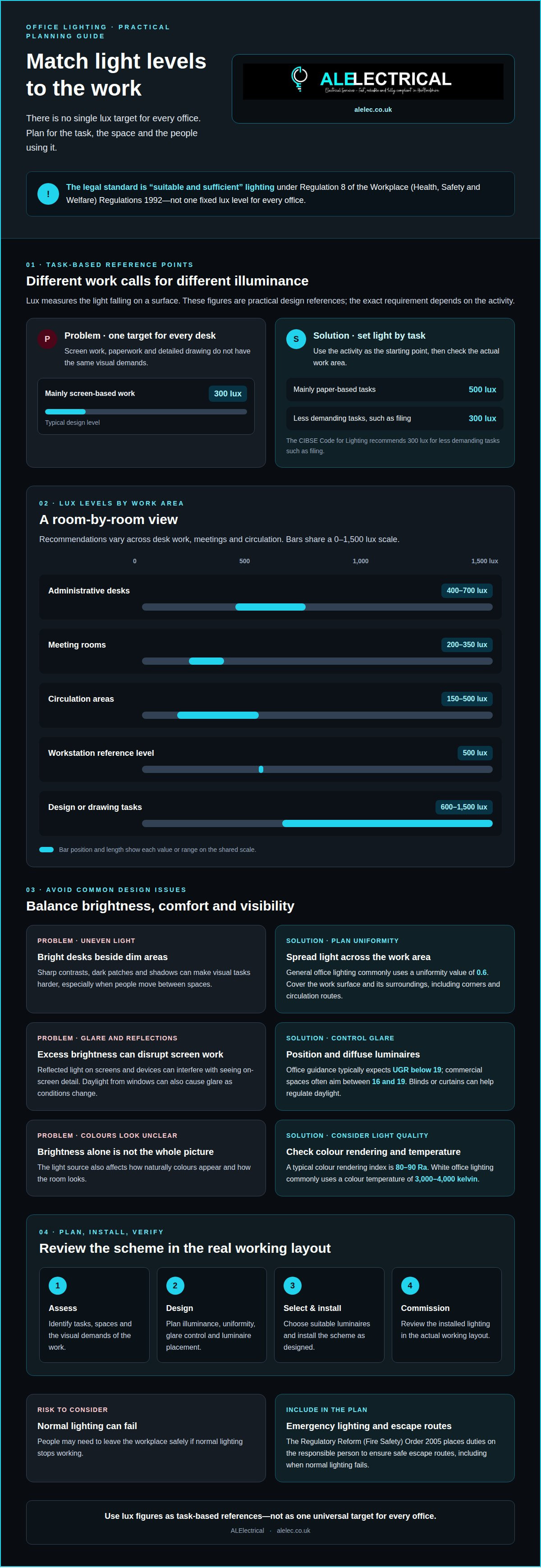
Recommended illuminance depends on the task and the space, so not every office area needs the same lux level. Use the figures as practical reference points when planning lighting for visual work and shared spaces.
Task-based illuminance levels
Task-based illuminance is the light level suited to the visual demands of a particular activity. It matters because screen work, reading documents and detailed drawing need different conditions. A typical design level is 300 lux for mainly screen-based office work, compared with 500 lux for mainly paper-based tasks. The CIBSE Code for Lighting recommends 300 lux for less demanding tasks such as filing. Choosing levels by task helps match the working environment to what people actually do.
Lux levels by work area
Lux levels by work area are recommended illuminance ranges for specific office spaces. They help distinguish desk work from circulation and meeting activities. European standard recommendations include 400-700 lux for administrative desks, 200-350 lux for meeting rooms and 150-500 lux for circulation areas. A workstation reference level is 500 lux. For design or drawing tasks, the recommended range is 600-1,500 lux, reflecting the extra visual detail involved. These levels guide lighting design, while the exact requirement depends on the activity carried out in each space.
Uniform illumination and shadows
Uniform illumination means distributing light consistently across work areas instead of creating sharp contrasts between bright and dim patches. Uneven light and shadows can make visual tasks harder, particularly when people move between a desk and nearby shared spaces. Position lighting to cover both the work surface and its surroundings. A bright pool of light on a desk against a dim background, for example, may feel less comfortable than a balanced layout. Review each work area, including corners and circulation routes.
What are Office Lighting Regulations?
UK workplace lighting involves legal duties, technical standards and practical design choices. Understanding office lighting installation regulations starts with distinguishing legal requirements from design guidance.
Employer and premises-controller responsibilities
These responsibilities cover providing suitable lighting and maintaining safe workplace conditions. According to the UK Government, Regulation 8 of the Workplace (Health, Safety and Welfare) Regulations 1992 requires suitable and sufficient lighting in every UK workplace. The Management of Health and Safety at Work Regulations 1999 also place lighting safety responsibilities on employers, the self-employed and people controlling non-domestic premises. The British Standards Institution (BSI) identifies BS EN12464-1:2021 as the British implementation of EN 12464-1:2021 and the primary standard for indoor workplaces.
Lighting controls and occupant comfort
Controls let occupants adjust artificial lighting to suit tasks, daylight and room use. Local controls can support comfort at individual work areas, while automated lighting systems can be programmed to switch off at set times, such as overnight or at weekends. For projects shaped by office lighting installation regulations, Part L also matters: it applies to non-domestic buildings and sets expectations for reducing energy use and carbon emissions. LEDs can reduce energy consumption by up to 75% compared with traditional lighting. Fluorescent, LED and smart systems differ in technology and controls, so consider energy use, task needs and how the space operates.
Electrical safety and certification
Electrical safety means lighting systems must be properly constructed, maintained and suitable for their purpose and environment under the Electricity at Work Regulations 1989. The applicable technical records depend on the electrical work carried out and the system affected.
Building control approval and notification
Whether work needs approval or notification depends on its scope and the building-control rules in England, Scotland, Wales or Northern Ireland. A lighting change may be part of wider building work, so assess the project as a whole rather than treating every fitting change in the same way.
Emergency lighting matters where people could face danger if normal lighting fails. The Regulatory Reform (Fire Safety) Order 2005 places duties on the responsible person to ensure safe escape routes. BS 5266 and BS EN 1838 are used to define emergency lighting requirements. For lighting-related electrical work, arrange electrical maintenance.
ALElectrical: EV Charger Installation
ALElectrical installs EV chargers for businesses planning workplace charging as part of a wider electrical project. This service does not replace office lighting design or compliance work, but it can be relevant if your premises also need charging facilities. Coordinating electrical projects helps you consider wider building requirements, including lighting and power.
For plans beyond lighting, ALElectrical also provides electrical maintenance, fuse-box upgrades, house rewires and solar and battery solutions. These services address different needs, from maintaining existing systems to upgrading or replacing them. The right work depends on your project and premises.
For a straightforward conversation about your electrical requirements, contact ALElectrical.
Plan your next lighting project with confidence
Applying office lighting installation regulations in a real workspace means translating requirements into decisions suited to its layout and daily use. Before work begins, identify the areas that need attention, how people use them and whether the room layout may change. This gives the project a clear basis and keeps lighting considerations aligned with the wider plans for the premises.
If lighting changes form part of a renovation or broader electrical project, consider how the work fits together before plans are finalised. A clear brief can help establish priorities and support a more coordinated result. For a conversation about your requirements, contact ALElectrical about office lighting. A considered next step can make it easier to move your plans forward.
Frequently Asked Questions
Why Is Good Lighting In The Workplace Important?
Good workplace lighting helps people see tasks clearly and use screens, documents and equipment comfortably. A poorly lit filing area, for example, can make labels harder to read, while uneven light around a computer may create distracting reflections. Matching lighting to the task and room layout supports clear visibility and can reduce avoidable visual strain during everyday work.
What UK building regulations apply to office lighting installation?
Part L of the Building Regulations applies to non-domestic buildings and sets expectations for reducing energy use and carbon emissions. In an office project, lighting choices are part of the building’s wider energy-performance considerations, particularly during new construction or refurbishment. The applicable building-control process depends on the work and the UK nation, so requirements can vary between projects.
What are the UK workplace lighting requirements under health and safety law?
UK employers must provide suitable and sufficient workplace lighting under Regulation 8 of the Workplace (Health, Safety and Welfare) Regulations 1992, according to the UK Government. Display-screen work also has specific provisions: the Workplace (Display Screen Equipment) Regulations 1992 require satisfactory lighting conditions and appropriate contrast. In practice, lighting should suit the work being done and avoid creating conditions that make tasks difficult to see.
What illuminance levels are recommended for UK office tasks under BS EN 12464-1?
Recommended illuminance depends on the activity: a typical design level is 300 lux for mainly screen-based work and 500 lux for paper-based tasks. For administrative desks, the cited European-standard range is 400-700 lux; detailed design or drawing work uses 600-1,500 lux. BS EN 12464-1:2021 is the British implementation of the indoor workplace standard, according to the British Standards Institution (BSI).
What emergency lighting and exit-sign requirements apply to UK offices?
Where people could face danger if normal lighting fails, suitable emergency lighting must help keep escape routes safe. The responsible person has this duty under the Regulatory Reform (Fire Safety) Order 2005; BS 5266 and BS EN 1838 are used to define emergency lighting requirements.
Comments