_.jpg)
Commercial Electrical Maintenance Checklist: A Practical UK Guide
Spotting an electrical warning sign is only the first step. A damaged cable or unusual smell needs to be recorded, assessed and followed up so the concern does not get forgotten. A commercial electrical maintenance checklist gives staff a consistent way to report what they observe and helps the person responsible for maintenance decide what to do next.
This guide covers visible checks staff can make without carrying out electrical work, what to record and when to arrange professional support. It also explains how to track actions and plan maintenance around your premises, equipment and level of risk. A repeatable process keeps checks practical and makes it easier to see which issues remain open.
Table of Contents
Why a Commercial Electrical Maintenance Checklist Supports Safer, More Reliable Premises
A commercial electrical maintenance checklist gives your team a consistent way to record routine observations, planned checks and follow-up actions. For each concern, it shows what was noticed, where and when it was reported, who is responsible and what happens next. That record helps prevent small issues from being overlooked and makes maintenance easier to organise.
Planned electrical maintenance involves checking systems, recording concerns and arranging suitable follow-up to help keep electrical installations safe and reliable. Dealing with issues before they disrupt work can support continuity, protect people on site and reduce avoidable interruptions. Clear records also help staff pass useful information to the person arranging maintenance or repairs.
What a checklist can, and cannot, tell you
Use the checklist for observations that don’t involve opening equipment or carrying out electrical work. Staff can note a cracked socket face, a visibly damaged cable, an unusual burning smell or a distribution board with blocked access. Record what they can see or smell, but don’t remove covers, test circuits or attempt repairs.
These observations do not replace inspection or testing by a competent person, or an Electrical Installation Condition Report (EICR) where one is appropriate. An electrical contractor can carry out installation work and maintenance. Formal checks assess conditions that a visual walk-round cannot establish.
UK workplace duties under the Electricity at Work Regulations 1989 depend on the electrical system, the workplace and the work being carried out. A checklist supports good oversight, but it does not prove that every legal duty has been met. Treat it as one part of a wider maintenance process, with inspection, testing and repairs suited to your premises.
Commercial Electrical Maintenance Checklist: Checks to Record Around Your Premises
Walk through accessible areas and note visible concerns without touching damaged equipment. A commercial electrical maintenance checklist is most useful when it tells staff what to look for and how to report it, rather than asking them to diagnose faults.
A practical checklist for routine workplace observations
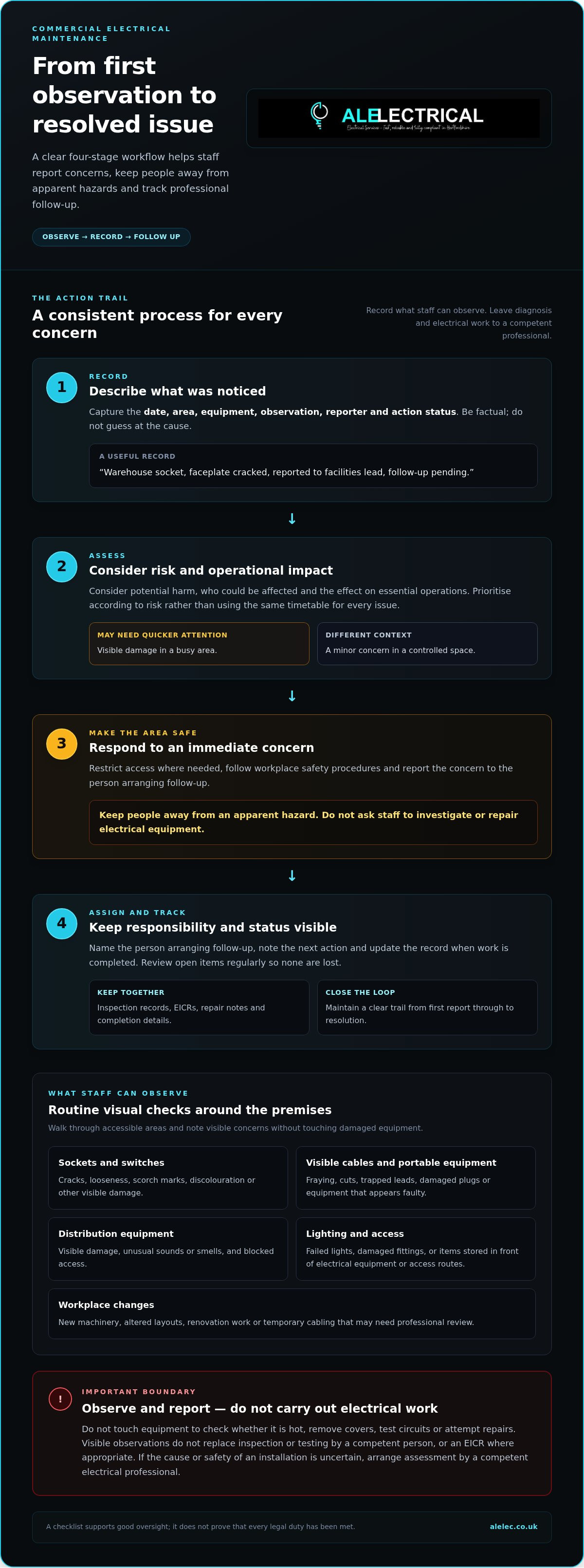
For each observation, record the date, area, equipment, what you noticed, who reported it and its action status. Be specific: “Warehouse socket, faceplate cracked, reported to facilities lead, follow-up pending” is more useful than “socket problem”. Include:
Sockets and switches: Cracks, looseness, scorch marks, discolouration or other visible damage.
Visible cables and portable equipment: Fraying, cuts, trapped leads, damaged plugs or equipment that appears faulty.
Distribution equipment: Visible damage, unusual sounds or smells, and whether access is blocked. Don’t open panels or remove covers.
Lighting and access: Failed lights, damaged fittings, or items stored in front of electrical equipment or access routes.
Workplace changes: New machinery, altered layouts, renovation work or temporary cabling that may need professional review.
Report visible damage or signs of overheating promptly. Don’t touch equipment to check whether it’s hot, and don’t attempt repairs. Keep people away from an apparent hazard and report it to the person responsible for arranging follow-up. The HSE electrical safety guidelines provide further workplace safety context.
Review the log regularly and check that every open item has an owner and next action. This makes it easier to distinguish unresolved concerns from completed work. For guidance on fitting observations into a wider maintenance plan, see our commercial electrical maintenance services guide. If findings point to work beyond a visual check, professional electrical maintenance support can help address the issue appropriately.
How to Record Findings, Prioritise Repairs and Arrange Professional Follow-Up
A checklist only helps when findings lead to action. Give each issue a clear status and owner, then review outstanding items so concerns aren’t lost between routine checks and professional visits.
Turn checklist findings into a clear maintenance plan
For each finding, record its location, what was observed, when it was reported, any immediate steps taken, who is responsible for follow-up and the current status. Keep inspection records, EICRs, repair notes and completion details together. A single record makes it easier to review the history and spot recurring issues.
Use a consistent workflow:
Record: Describe the issue factually, without guessing at its cause.
Assess: Consider potential harm, who could be affected and the impact on essential operations.
Make the area safe: If there’s an immediate concern, restrict access and follow your workplace safety procedures. Don’t ask staff to investigate or repair electrical equipment.
Assign and track: Name the person arranging follow-up, note the next action and update the record when work is completed.
Prioritise according to risk and operational impact, rather than applying the same timetable to every issue. For example, visible damage in a busy area may need quicker attention than a minor concern in a controlled space. If the cause or safety of an installation is uncertain, arrange assessment by a competent electrical professional. They can advise whether inspection, testing, an EICR or remedial work is appropriate. The IET electrical safety codes of practice offer further guidance for safe electrical work.
Use your commercial electrical maintenance checklist to keep the action trail current, from the first report through to resolution. For more detail on inspection reports, see our EICR guide. ALElectrical provides electrical maintenance and repairs for commercial premises. You can request a free, no-obligation quote to discuss the work required.
Keep Your Maintenance Plan Moving
A checklist is more valuable when it remains part of how your workplace is managed, rather than being completed once and filed away. Set a review point that suits your premises, assign responsibility for outstanding actions and update the record when equipment or working areas change. This keeps your commercial electrical maintenance checklist relevant as your business evolves.
When observations need professional assessment, ALElectrical provides commercial electrical maintenance, EICR inspections and electrical repairs. These services can support appropriate follow-up and help you plan the work your premises require.
Request a free, no-obligation quote for electrical maintenance to discuss the next steps for your workplace.
Frequently Asked Questions
Is a commercial electrical maintenance checklist a legal requirement in the UK?
No, UK workplace law doesn’t prescribe a specific checklist format. The Electricity at Work Regulations 1989 require electrical systems to be maintained, as necessary, to prevent danger. A written checklist can help a business organise observations and follow-up, but it isn’t proof by itself that legal duties have been met. Appropriate arrangements depend on the workplace and its electrical systems.
How often should commercial electrical equipment be checked?
There’s no single interval that suits every business or type of check. Set routine observation intervals according to risk, equipment use and workplace conditions. For formal EICRs, commonly used guidance is every five years for offices and shops, every three years for industrial premises, and annually for some special locations. These are general intervals, not a universal timetable for all equipment.
Can employees carry out commercial electrical maintenance checks themselves?
Employees can make routine visual observations if they’ve been shown what to report and how to do so safely. For example, they might flag a damaged plug or a cable that’s been crushed under furniture. They shouldn’t open electrical equipment, remove covers, test circuits or carry out repairs unless they’re competent and authorised for that work.
Does a maintenance checklist replace an EICR or PAT testing?
No. A checklist records observations, whereas an EICR assesses the condition of a fixed electrical installation through a formal inspection and testing process. Portable appliance testing (PAT) relates to portable electrical equipment and should be managed according to the risks and how items are used. The commercial electrical maintenance checklist helps track concerns between these activities, but it doesn’t replace them.



Comments