_.jpg)
Do I Need a New Consumer Unit for an EV Charger?
What if your existing consumer unit can support an EV charger after all? If you’re asking, “do i need a new consumer unit for an ev charger?”, the answer isn’t automatically yes. It depends on the condition and capacity of your electrical installation, and whether it can safely accommodate the charger’s circuit and protection.
It’s understandable to worry that adding a charger means replacing the consumer unit. An electrician can assess its condition, available capacity and existing circuit arrangements, then identify any safety concerns. If the unit isn’t suitable, an upgrade or other remedial work may be needed, but replacement isn’t a given.
This guide explains what affects suitability, what an electrician will inspect and when an upgrade could be appropriate. ALElectrical provides EV charger installation and consumer unit upgrades, helping you understand the practical next step towards a safe installation.
Table of Contents
Do I need a new consumer unit for an EV charger? Not necessarily
No. A new consumer unit isn’t automatically needed for every EV charger installation. If you’re wondering, “do i need a new consumer unit for an ev charger?”, the answer depends on the condition and capacity of your existing installation, its circuit arrangements and whether its protective devices are suitable.
The consumer unit is the central board that distributes electricity around your property and contains protective devices for the circuits. The UK term is used for this type of consumer unit. A dedicated charger circuit is a separate electrical route from the board to the EV charger. The electrician assesses whether the circuit can be added safely and connected appropriately.
What makes an existing consumer unit suitable?
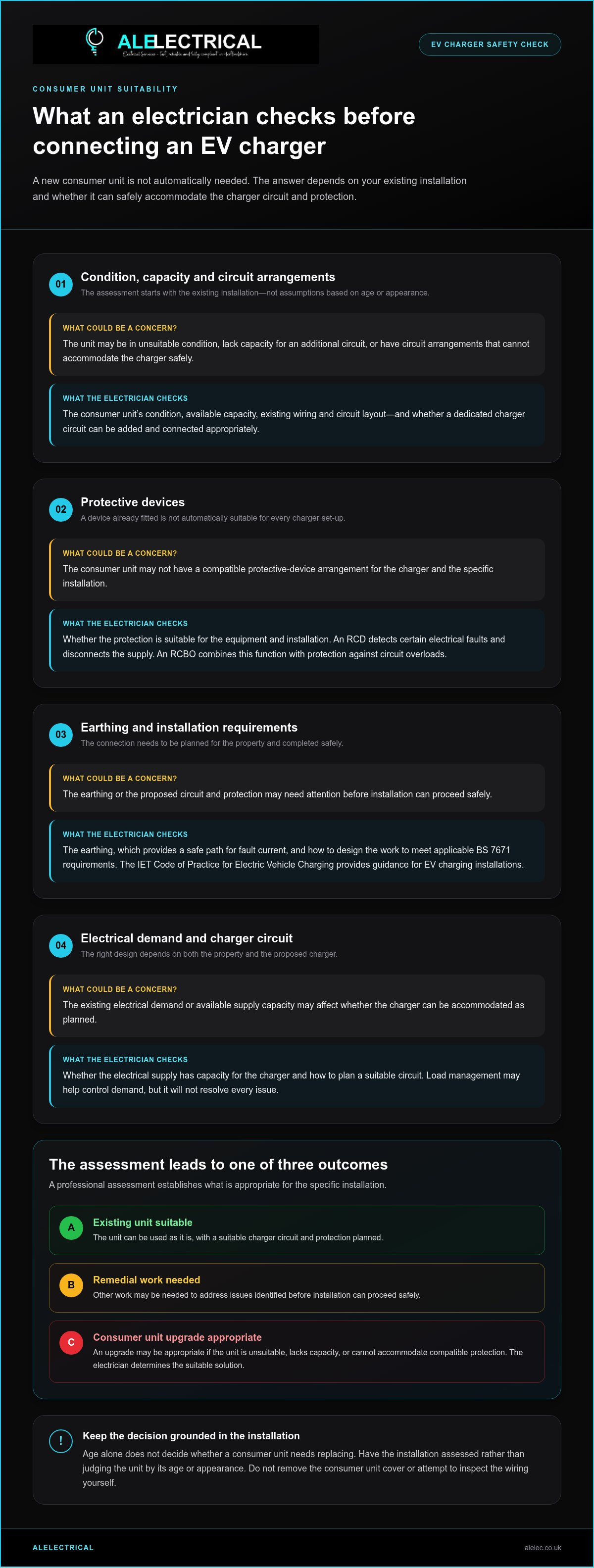
Age alone doesn’t decide whether a unit needs replacing. An electrician considers its condition, whether the installation can accommodate the charger’s additional demand, and whether the protective devices can provide suitable protection. They’ll also review how the circuits are arranged and whether the unit can accommodate a suitable circuit for the charger.
Protective devices such as RCDs or RCBOs help reduce the risk of electric shock by disconnecting the supply when a fault is detected. The right arrangement depends on the equipment and installation, so an RCD or other device already fitted in the unit isn’t automatically suitable for every charger setup.
The assessment determines the next step. The existing unit may be suitable as it is, may need remedial work, or may need upgrading. This is why a professional electrical assessment is more useful than judging the unit by its age or appearance alone.
What an electrician checks before connecting an EV charger
An electrician assesses the installation in stages rather than assuming the consumer unit must be replaced. They’ll inspect the unit and existing wiring, consider whether the electrical supply has capacity for the charger, review the protective devices and plan a suitable circuit for the connection.
Protection matters. An RCD detects certain electrical faults and disconnects the supply, while an RCBO combines this function with protection against circuit overloads. The correct arrangement depends on the charger and the installation. The electrician will also check the earthing, which provides a safe path for fault current, and design the work to meet applicable BS 7671 requirements. The IET’s IET Code of Practice for Electric Vehicle Charging provides guidance for EV charging installations.
Circuit design can depend on the property’s existing electrical demand and the proposed charger. Load management may help control demand, but it won’t resolve every issue. The assessment may also identify remedial work that needs to be completed before installation can proceed safely.
Which findings can mean an upgrade is needed?
An upgrade may be appropriate if the consumer unit is in unsuitable condition, lacks capacity for the additional circuit, or can’t accommodate a compatible protective-device arrangement. The electrician will determine whether replacing the unit or another compliant remedial solution is suitable for the specific installation. For more detail on replacement options, see our consumer unit upgrade guide.
A professional assessment is the practical way to establish whether you need a new consumer unit for an EV charger or whether another solution is appropriate. ALElectrical can assess your installation and plan the work needed for EV charger installation. Explore EV charger installation.
Your next steps for a safe EV charger installation
Start with a professional assessment. The electrician reviews the existing installation and your planned charger location, then explains whether the consumer unit can be used as it is, needs remedial work or should be upgraded. Once the findings are clear, the installation design can be agreed before work begins. Final checks help confirm that the completed installation is safe and functioning as intended.
An assessment may show that your existing consumer unit is suitable, so replacement shouldn’t be assumed. If you’re still asking, “do i need a new consumer unit for an ev charger?”, this step gives you an answer based on your property rather than guesswork. In England, Approved Document S building regulations provides official guidance on infrastructure for charging electric vehicles.
What to prepare before arranging an assessment
A few details can make the initial discussion more useful:
Note where the consumer unit is and any visible labels. Don’t remove its cover or attempt to inspect the wiring yourself.
Identify where you’d like the charger installed, such as on an outside wall or in a garage.
Share any known electrical issues or relevant information about your property’s electrical installation.
You can also read our professional EV charging installation guide for more about the process. With these details, ALElectrical can assess the installation, explain any work required and provide a free, no-obligation quote for EV charger installation. Request a free, no-obligation quote to take the next step towards a safe installation.
Take the next step with confidence
So, do i need a new consumer unit for an ev charger? Not necessarily. Whether your existing unit can remain depends on its condition, available capacity, circuit arrangements and suitable protective devices. A professional assessment gives you a clear answer and identifies any work needed before installation.
ALElectrical installs EV chargers and upgrades consumer units, with safety, compliance and customer satisfaction at the heart of its work. Once your electrical installation has been assessed, you can understand the recommended approach and plan the next steps with confidence.
Get a tailored assessment of your installation and understand what the work involves. Request a free, no-obligation quote for your EV charger installation.
Frequently Asked Questions
Is a new consumer unit always needed for an EV charger?
No, a new consumer unit isn’t automatically needed. An existing unit may be suitable if it’s in good condition, has enough capacity and can accommodate the required dedicated circuit and protective devices. An electrician needs to assess the installation, including its earthing and RCD arrangements. If it can’t meet the design requirements safely, an upgrade or other remedial work may be necessary.
Can an EV charger be installed with an old consumer unit?
Possibly. Age alone doesn’t determine whether a consumer unit is suitable. Its condition, available capacity, circuit arrangements and protective devices all matter. An electrician should inspect the installation and decide whether it can support the charger safely. If the unit isn’t suitable, a consumer unit upgrade or other remedial work may be needed before the charger can be installed.
Does an EV charger need its own circuit?
Generally, an EV charger is supplied by a dedicated circuit designed for the charger and the property’s electrical installation. The circuit and protective arrangements are assessed as part of the installation design. This doesn’t automatically mean the whole consumer unit needs replacing. An electrician will also check whether the existing unit can safely accommodate the circuit and required protection.
Can load management avoid replacing a consumer unit for an EV charger?
It may help, but load management doesn’t resolve every consumer-unit issue. It can help balance charger demand with other electrical use, but the unit must still be in suitable condition and support the required circuit and protective arrangements. An electrician can assess whether load management suits the installation or whether remedial work or an upgrade is also needed.

Comments