_.jpg)
EICR Report Explained for Tenants: Understand the Codes and Your Next Steps
An electrical code on your EICR can look alarming, but it doesn’t always mean there’s immediate danger. If you’re looking for an eicr report explained for tenants, you probably want to know how serious the finding is and who should take action.
Reports use codes such as C1, C2, C3 and FI, and it can be hard to tell which need prompt attention. This guide explains what the report covers, how to read its overall outcome and observations, and what to ask your landlord or letting agent. The key is to read each code with the inspector’s description and recommended action, rather than relying on the code alone.
Table of Contents
EICR report explained for tenants: what the inspection report tells you
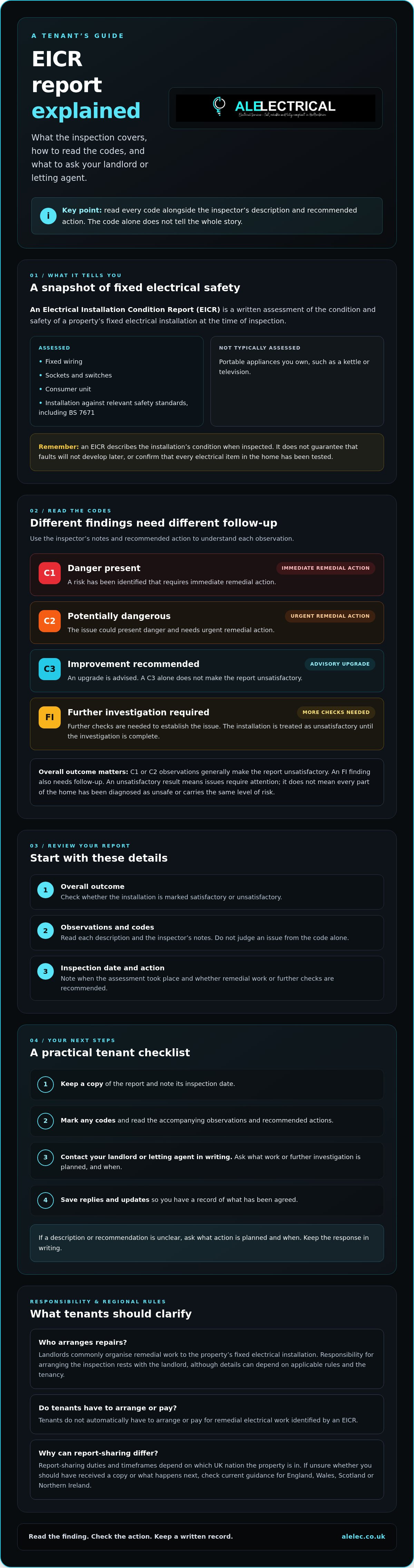
An Electrical Installation Condition Report (EICR) is a written assessment of the condition and safety of a property’s fixed electrical installation at the time of inspection. If you’re looking for an eicr report explained for tenants, start with what is covered: fixed wiring and components such as sockets, switches and the consumer unit. The inspection doesn’t typically assess portable appliances you own, such as a kettle or television.
The inspector assesses the installation against relevant safety standards, including the BS 7671 wiring regulations, and records observations in the report. An EICR describes the installation’s condition when inspected. It doesn’t guarantee that faults won’t develop later or confirm that every electrical item in the home has been tested.
Which details should tenants look for first?
Start with the overall assessment, often labelled as the outcome or summary. Check whether the installation is marked satisfactory or unsatisfactory, then read each observation and its classification code. The code indicates the type and seriousness of the finding; the inspector’s notes explain what was observed and what action is recommended.
Overall outcome: Check whether the installation is recorded as satisfactory or unsatisfactory.
Observations and codes: Read the description and inspector’s notes alongside each code. Don’t judge the issue from the code alone.
Inspection date and action: Note when the assessment took place and whether the report recommends remedial work or further checks.
If a description or recommendation is unclear, ask your landlord or letting agent what action is planned and when. Keep the response in writing. The next section explains what each code means.
What EICR codes mean for tenants: from urgent danger to recommendations
The codes classify the inspector’s observations and indicate what needs attention. Read each one alongside the description of the issue and any recommended action. The government guidance on electrical safety standards explains the classifications used in relevant rented-property guidance.
C1, danger present: A risk has been identified that requires immediate remedial action.
C2, potentially dangerous: The issue could present danger and needs urgent remedial action.
C3, improvement recommended: An upgrade is advised, but a C3 alone doesn’t make the report unsatisfactory.
FI, further investigation required: More checks are needed to establish the issue. The installation is treated as unsatisfactory until the investigation is complete.
C1 or C2 observations generally make the report unsatisfactory. An FI finding also needs follow-up, so check the overall outcome and recommended action rather than focusing on one code. C1 and C2 identify danger that needs action; C3 recommends an improvement without making the report unsatisfactory on its own.
Does an unsatisfactory EICR mean the property is unsafe?
An unsatisfactory result means the inspection recorded one or more issues requiring attention. It doesn’t mean every part of the home has been diagnosed as unsafe or that every circuit presents the same level of risk. Ask your landlord or letting agent what work or investigation is planned, and when. Keep their reply in writing.
Tenants don’t automatically have to arrange or pay for remedial electrical work identified by an EICR. Responsibility for arranging the inspection rests with the landlord, although the details can depend on the applicable rules and tenancy. Landlords and property owners can arrange professional EICR safety inspections from ALElectrical.
What tenants should do after receiving an EICR report
Use the report to establish a clear next step instead of trying to interpret technical findings alone. This practical approach to eicr report explained for tenants helps you track the observations, who you’ve contacted and what response you receive.
Keep a copy of the report and note its inspection date.
Mark any codes and read the accompanying observations and recommended actions.
Contact your landlord or letting agent in writing to ask what work or further investigation is planned, and when.
Save replies and updates so you have a record of what’s been agreed.
Report-sharing duties and timeframes depend on which UK nation the property is in. If you’re unsure whether you should have received a copy or what should happen next, check current guidance for England, Wales, Scotland or Northern Ireland. Electrical Safety First’s guide for tenants offers further information on electrical safety in rented homes.
Who arranges electrical repairs, and when should you raise concerns?
Landlords commonly organise remedial work to a property’s fixed electrical installation, subject to the applicable rules and the circumstances of the tenancy. Raise concerns promptly with your landlord or agent, particularly if the report identifies work that hasn’t been discussed. If an observation mentions the consumer unit, this fuse box upgrade guide explains the component in more detail.
If you see signs of immediate danger, such as smoke, sparks or a burning smell, keep clear and alert your landlord or agent straight away. Seek appropriate emergency help if anyone may be at risk. If you’re a landlord or property owner arranging an inspection, you can enquire about ALElectrical’s EICR service.
Take your next step with confidence
With an eicr report explained for tenants, the codes are easier to act on: C1 and C2 observations call for urgent attention, C3 recommends an improvement, and FI means further investigation is needed. Check the overall outcome, keep a copy and ask your landlord or letting agent what action is planned. Rules and report-sharing timeframes vary across the UK, so check the guidance for your nation if you’re unsure about your position.
A clear, professionally prepared report records the findings and recommended actions from an inspection. ALElectrical provides EICR inspections, with safety, compliance and customer satisfaction among its priorities. If you’re arranging an inspection, contact ALElectrical to discuss an EICR and request a free, no-obligation quote.
Frequently Asked Questions
What does an unsatisfactory EICR report mean for a tenant?
An unsatisfactory report means the inspection recorded findings that need further action, not that every part of the property has been diagnosed as unsafe. C1 or C2 codes make a report unsatisfactory; an FI observation also requires investigation before the installation can be considered satisfactory. Ask your landlord or letting agent what work or checks are planned and when. These are the key points in an eicr report explained for tenants.
Can a tenant ask for a copy of the EICR report?
Yes. Ask your landlord or letting agent for a copy if you haven’t received one. Report-sharing rules and deadlines differ across the UK. In England, landlords must provide existing tenants with a copy within 28 days of the inspection, and new tenants before they occupy the property. Check the current rules for your nation if you rent in Wales, Scotland or Northern Ireland.
What do C1, C2, C3 and FI mean on an EICR?
C1 means danger is present and immediate remedial action is required. C2 identifies a potentially dangerous condition needing urgent action. C3 recommends an improvement but, by itself, doesn’t make the report unsatisfactory. FI means further investigation is needed to establish the issue. Read each code alongside the inspector’s description and recommended action, and ask your landlord or agent about any unclear finding.
Do tenants have to pay for EICR repairs?
Tenants don’t automatically have to arrange or pay for remedial work identified in an EICR. Landlords commonly organise repairs to the fixed electrical installation, but responsibility can depend on the applicable law, tenancy terms and circumstances, such as damage caused by a tenant. Contact your landlord or agent before arranging work yourself, and keep a written record of the discussion.



Comments