
Planning permission for roof and ground solar panels
Roof-mounted panels and a garden array can face very different planning rules. Whether you need planning permission for solar panels in the UK depends on the nation, the property and where the panels will be installed. In England, roof-mounted systems may qualify as permitted development if they meet the relevant limits and conditions. Ground-mounted systems are assessed separately.
It’s understandable to want a clear answer before committing to a design. This guide explains when permission may be needed, how the rules differ across England, Scotland, Wales and Northern Ireland, and what applies to ground-mounted panels. In England, domestic stand-alone solar panels have a maximum area of 9 square metres under the revised rules, according to UK Legislation. You’ll also see why listed buildings, conservation areas and local restrictions can affect the planning route.
Table of Contents
Do you need planning permission to install solar panels?
In England, domestic solar panels may count as permitted development, meaning a planning application may not be required. The installation must meet the applicable limits and conditions, which vary across the UK.
Permitted development rights for solar panels
Permitted development rights allow certain domestic solar installations without a planning application when specified conditions are met. In England, they are set out in Part 14 of the Town and Country Planning (General Permitted Development) (England) Order 2015, according to UK Legislation. This helps homeowners understand when rooftop panels may proceed under those rights. Wales has separate planning policy, so England’s rules should not be assumed to apply there.
Limits and conditions on permitted development
Limits set the circumstances in which an installation can use permitted development rights. Under England’s revised rules, domestic stand-alone panels retain a maximum panel area of 9 square metres, according to UK Legislation; rooftop equipment must not extend above the roof’s highest part, excluding chimneys. Panels should minimise effects on appearance and local amenity where practicable. Planning permission is separate from building regulations approval and electrical certification; the requirements depend on the installation.
Transition to updated permitted development rights
The transition period protects certain domestic solar developments affected by England’s revised rules. Those changes took effect on 27 August 2026, and qualifying development that lost permitted development rights under them may proceed until the end of 26 August 2027. This deadline matters if a design relies on the previous rules; it does not make every proposed installation permitted. Check which rules apply to the development date and design.
Objections from neighbours and councils
Neighbours can raise concerns with the council if an installation needs a planning decision, but an objection alone does not establish whether permission is required. Local restrictions, including an Article 4 Direction or a World Heritage Site designation, can affect permitted development rights. To check your requirements, give the local planning authority the property location, panel position and proposed design, and ask which limits or approvals apply. A Lawful Development Certificate can provide evidence that permission is not required.
Planning rules in Scotland, Wales and Northern Ireland
Planning rules for domestic solar differ between the UK’s devolved nations. Your home’s location determines which permitted development limits and approval processes apply.
Differences in devolved planning rules
England’s permitted development rights do not automatically apply in Scotland, Wales or Northern Ireland. This distinction matters for both roof-mounted systems and ground arrays, since relevant limits and planning processes vary by nation.
In Scotland, solar panel installations of 50 kW or above require prior approval from the local planning authority, even if they would otherwise qualify as permitted development. For a smaller installation, this specific threshold does not apply, but other planning requirements may still matter. In Wales, planning policy may differ from England’s. Northern Ireland also has its own planning system, so use the relevant local council’s planning portal to identify the rules for your property.
Changes to domestic solar rules
England’s updated domestic solar rules took effect on 27 August 2026, but that date does not make them UK-wide. A homeowner in Wales, Scotland or Northern Ireland should not rely on England’s revised limits when planning an installation.
Protected settings can add another layer. For example, a listed property or a home in a conservation area may face requirements beyond the standard route; the relevant local planning authority can explain which application or prior approval applies. The same care is needed where panels sit near a highway or within a property’s curtilage. Once the correct planning route is clear, solar and battery systems can be planned around the property and its electrical needs.
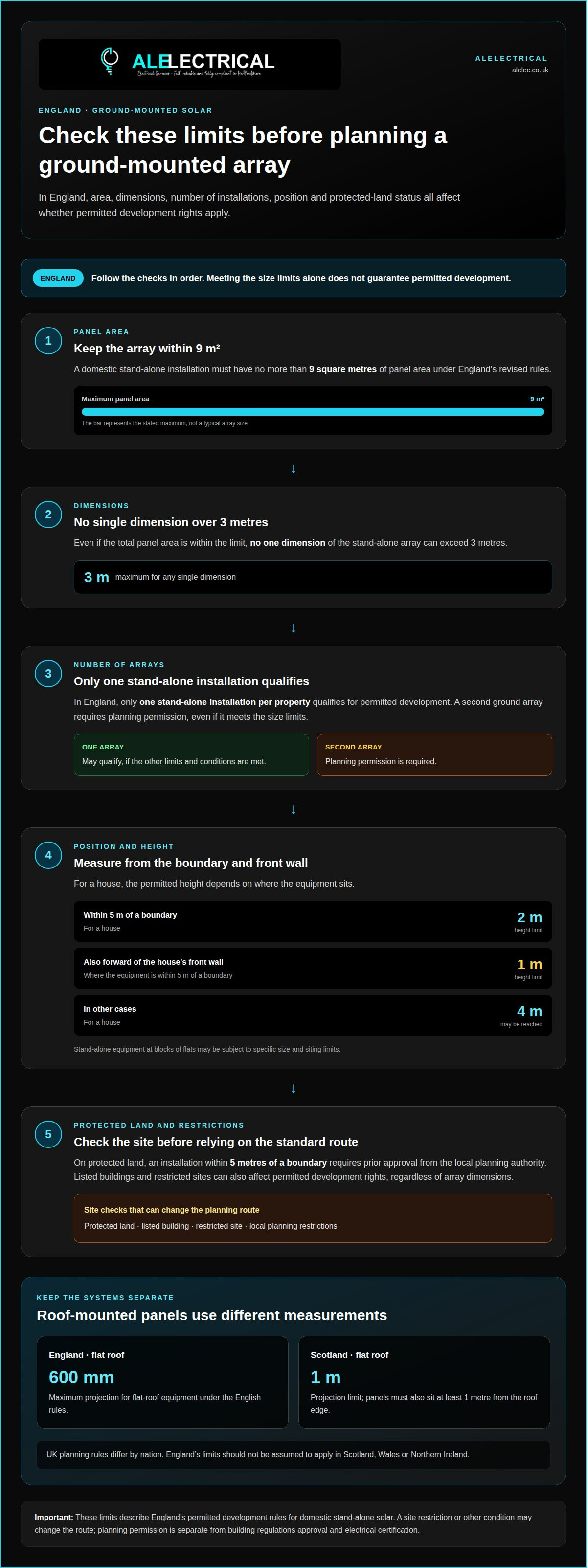
Ground-mounted solar panel size and siting limits
In England, ground-mounted solar has different permitted development limits from roof panels. The array’s size, height, position and setting affect whether permitted development rights apply, and whether you may need planning permission for solar panels in the UK.
A domestic stand-alone array must have no more than 9 square metres of panel area, according to UK Legislation. No single dimension can exceed 3 metres. The revised rules also distinguish between installations near a boundary and those elsewhere. Only one stand-alone installation per property qualifies for permitted development in England. A second ground array requires planning permission, even if it would fit within the size limits.
For a house, equipment within 5 metres of a boundary is limited to 2 metres high. If it is also forward of the house’s front wall, the limit is 1 metre. In other cases, it may reach 4 metres. Stand-alone equipment at blocks of flats may be subject to specific size and siting limits. On protected land, an installation within 5 metres of a boundary requires prior approval from the local planning authority.
Roof-mounted solar follows different measurements. In England, panels must not extend above the roof’s highest part, excluding chimneys. Flat-roof equipment may project up to 600 millimetres under the English rules. Scotland’s flat-roof projection limit is 1 metre, and panels must also sit at least 1 metre from the roof edge.
A listed building or restricted site can affect permitted development rights, regardless of array dimensions. Before settling on a layout, consider how planning permission for solar panels in the UK applies to the proposed position. Plan your solar and battery installation around its position and applicable limits.
ALElectrical: Solar & Battery
ALElectrical provides Solar & Battery solutions for homeowners planning an installation. Once you understand the relevant planning route, consider how panels and battery storage will fit your property and electrical requirements.
If your existing electrical system needs attention as part of a wider project, ALElectrical also provides House Rewires, Fuse Box Upgrades and EICR inspections. These services cover related electrical work, but do not replace planning permission or approval from your local authority. Keeping these responsibilities separate helps you plan the installation in the right order.
Ready to discuss a solar and battery project? Contact ALElectrical to talk through your requirements.
Make your solar plans with confidence
Planning permission for solar panels in the UK is only one part of preparing for an installation. Bring the planning route and electrical work together so the proposed system suits your property and project. If your plans also involve changes to the wiring or fuse box, consider those requirements alongside the solar work.
ALElectrical offers Solar & Battery solutions, House Rewires and Fuse Box Upgrades. For a straightforward discussion about your project and its electrical requirements, contact ALElectrical about solar panels. With the right information in hand, you can take the next step towards a solar installation that fits your home.
Frequently Asked Questions
Can you get solar panels on a listed building?
Yes. In England, installing solar panels on a listed building requires listed building consent, even if the work might otherwise qualify as permitted development. Listed building consent is separate from planning permission, so a proposal may need one or both. Installing panels without consent is a criminal offence, and the local authority can require their removal at the owner’s expense.
Does planning permission work differently in Scotland and Wales?
Yes. Planning policy is devolved, so England’s permitted development rules don’t automatically apply in Scotland or Wales. In Scotland, solar installations of 50 kW or above require prior approval from the local planning authority, even if they would otherwise qualify as permitted development. Wales has its own planning policy, so the relevant Welsh authority’s rules matter for a home installation there.
Solar panels in a conservation area: what are the rules?
Conservation area status can affect where panels may be installed and whether extra approval is needed. For example, a stand-alone panel closer to an adjoining highway than the property requires an application to the local planning authority for a prior-approval determination before installation. An Article 4 Direction can remove permitted development rights, meaning a full planning application may be required.
What are permitted development rights?
Permitted development rights allow certain building work to proceed without a planning application, provided the relevant conditions are met. They don’t remove separate requirements such as listed building consent, or restrictions imposed by an Article 4 Direction. If you need written evidence that a solar proposal doesn’t require planning permission, you can apply to the local planning authority for a Lawful Development Certificate.
What if I need to apply for planning permission in a conservation area?
Submit the proposal to the local planning authority, which considers the installation against applicable planning rules and the area’s character. Some proposals may instead need a prior-approval determination. A decision on a solar-panel planning application in a conservation area can take 8 to 13 weeks. Avoid starting work that needs consent until the authority has made its decision.
Comments