_.jpg)
The Ultimate Guide to Professional EV Charging Installation in 2026
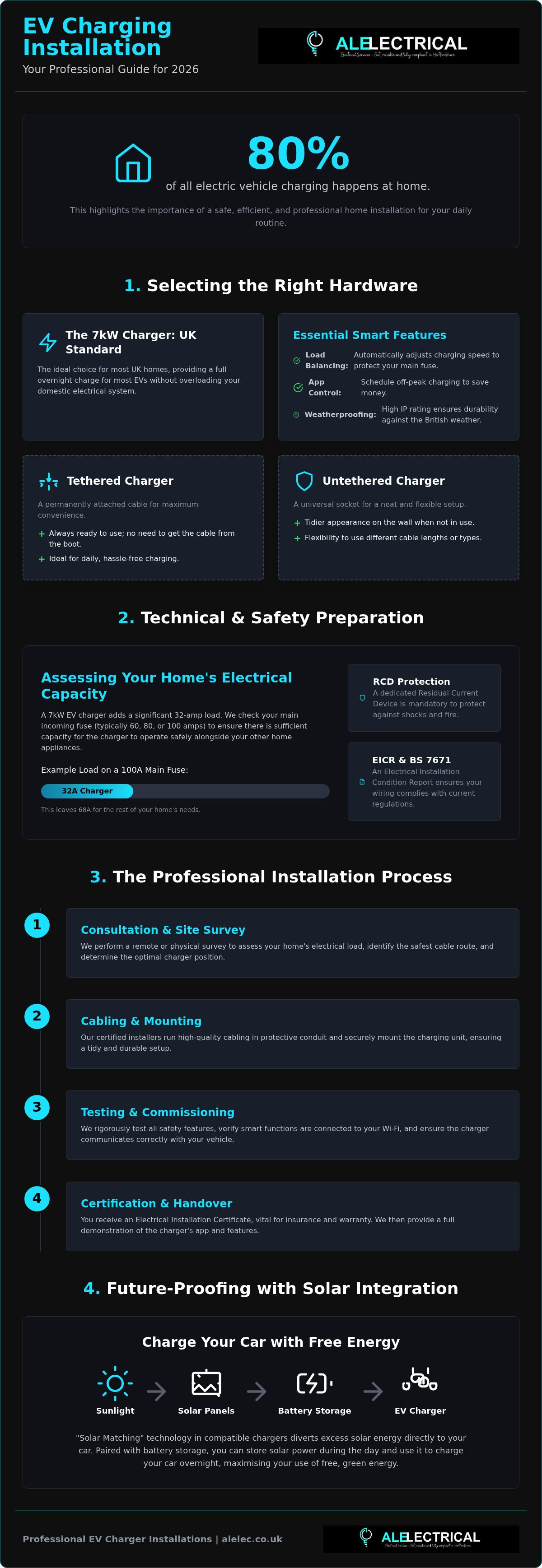
Did you know that despite the rapid growth of public networks, 80% of electric vehicle charging still happens right on your own driveway? It's a statistic that highlights why getting your home setup right is so important for your daily routine. We understand that while the transition to electric driving is exciting, the technical details can feel a bit daunting. You might be worrying if your existing fuse box can handle the extra demand or struggling to choose between tethered and untethered cables. This guide explains everything you need to know about a professional EV charging installation in 2026.
We'll show you how to prepare your home for a safe and future-proof charging point. You'll discover how to navigate OZEV grant eligibility, integrate your charger with solar panels, and ensure your installation meets the high standards required for insurance and warranty protection.
Table of Contents
Selecting the Right Hardware for Your EV Charging Installation
Selecting the right equipment is the first step toward a successful ev charging installation. For most UK households, a 7kW charger is the ideal choice. It provides enough power to fully charge most modern electric vehicles overnight without overloading your home's electrical system. Before you decide on a model, it's helpful to understand EV charging station basics, such as how AC power works in a domestic setting.
You'll need to choose between a tethered and an untethered unit. A tethered charger comes with a permanently attached cable, which is convenient for daily use. An untethered version features a socket instead. This looks neater on your wall and allows you to use different cables if needed. Look for smart features like load balancing, which protects your main fuse, and over-the-air updates that keep your software secure. High-quality weatherproofing amongst leading brands ensures your equipment remains reliable for years.
Solar Integration: Charging Your Car with Free Energy
If you have solar panels, choosing a compatible charger is a smart move. "Solar Matching" technology allows the unit to monitor your energy production and divert excess electricity straight into your car. This ensures your ev charging installation is fully integrated with your renewable energy sources. This process works best when paired with home solar battery storage. Your system can store solar energy during the day and discharge it later. Investing in solar-ready hardware now prevents expensive future upgrades.
Technical Requirements and Property Preparation
Before any hardware is mounted, we must look at your home's electrical backbone. A standard 7kW ev charging installation adds a constant 32-amp demand to your system. This is a significant load, often equivalent to running a high-power electric shower for several hours at a time. We check your main incoming fuse, usually rated at 60, 80, or 100 amps, to ensure there's enough capacity for your car to charge whilst you're using other appliances. Understanding home charging requirements is essential for maintaining a safe and efficient environment.
Safety isn't just about the charger; it's about the protection built into your consumer unit. Modern installations require dedicated RCD (Residual Current Device) protection to prevent electric shocks and fire risks. We always perform a thorough site survey, either physically or remotely, to identify the best cable route. This prevents hidden costs like unexpected groundworks or complicated wiring runs from appearing on the final invoice. It's a straightforward step that ensures your installation day runs smoothly.
The Role of Fuse Box Upgrades and EICR
For period properties, the existing electrical system might not be up to the task. A house rewiring or a targeted fuse box upgrade ensures your home can handle modern energy management. We use an EICR (Electrical Installation Condition Report) to verify that your wiring is in good condition and complies with the latest BS 7671 regulations. This provides peace of mind that your new ev charging installation won't compromise your home's safety. If you're concerned about an older fuse box, we can arrange a safety inspection to check your property's readiness.
The Professional EV Charging Installation Process
A truly professional ev charging installation begins with a detailed consultation. We assess your home's load to find the safest cable route and most accessible charger position. Once agreed, our team carries out the physical work. We use high-quality cabling and protective conduit to ensure the setup is durable and looks tidy. This meticulous planning mirrors the standards found in the EV infrastructure playbook, ensuring your home setup is as robust as public networks.
After mounting the hardware, we move to testing and commissioning. It's not just about turning it on; we verify that all safety cut-offs work and that the smart features connect to your Wi-Fi correctly. Finally, we provide an Electrical Installation Certificate. This document is vital for your insurance and vehicle warranty. We'll walk you through the app, showing you how to schedule charges during off-peak hours to save money whilst keeping your battery healthy and your home energy usage efficient.
OZEV Grants and Compliance for 2026
In 2026, OZEV grants remain a valuable resource for landlords and tenants living in flats. To qualify for this government support, your charger must have smart functionality to help manage the grid's demand. It's essential to use an OZEV-authorised installer, as they're the only ones permitted to sign off on grant-funded work. We'll help you check your current eligibility for an ev charging installation to ensure you don't miss out on potential cost savings whilst upgrading your home energy system.
Ready to Power Your Future?
Transitioning to an electric vehicle is a significant step towards a more sustainable lifestyle. By choosing the right 7kW hardware and ensuring your home’s electrical system is ready, you’re investing in years of reliable, cost-effective driving. A professional setup offers the peace of mind that comes with certified safety and seamless integration with your existing energy management, protecting both your vehicle and your property.
Our team of fully qualified professional electricians are experts in solar and battery integration. We pride ourselves on providing transparent, fixed-fee technical services that take the guesswork out of your home upgrade. Get a free, no-obligation quote for your EV charging installation today. We look forward to helping you make the most of your new electric journey.
Frequently Asked Questions
How long does a standard EV charging installation take?
A standard ev charging installation usually takes between three and four hours to complete. This timeframe includes mounting the unit, running the necessary cabling, and performing essential safety tests. If your consumer unit is far from the driveway or requires significant routing through internal walls, the process might take slightly longer. We always aim to minimise disruption whilst ensuring the setup is fully commissioned.
Can I install an EV charger if I only have a single-phase supply?
Yes, most domestic properties in the UK operate on a single-phase supply, which is perfectly capable of supporting a 7.4kW smart charger. This setup provides a reliable overnight charge for the majority of modern electric vehicles. Our team will assess your main fuse capacity during the initial survey to ensure your home can safely manage the additional 32-amp load alongside your existing appliances.
Do I need permission from my landlord or the council for installation?
If you are a tenant, you must obtain written consent from your landlord before proceeding with an ev charging installation. For homeowners, planning permission is generally not required for chargers installed on off-street parking areas under Permitted Development rights. However, it's best to check with your local council if your property is a listed building or located within a designated conservation area.
What is the difference between a standard installation and a complex one?
A standard installation typically involves a short cable run of up to 10 metres between your consumer unit and the charger, with no need for trenching or lifting floorboards. A complex installation might require a longer cable route, groundworks to bury cables, or a necessary fuse box upgrade to meet modern safety standards. We identify these requirements during our survey to provide a clear, transparent plan.


Comments